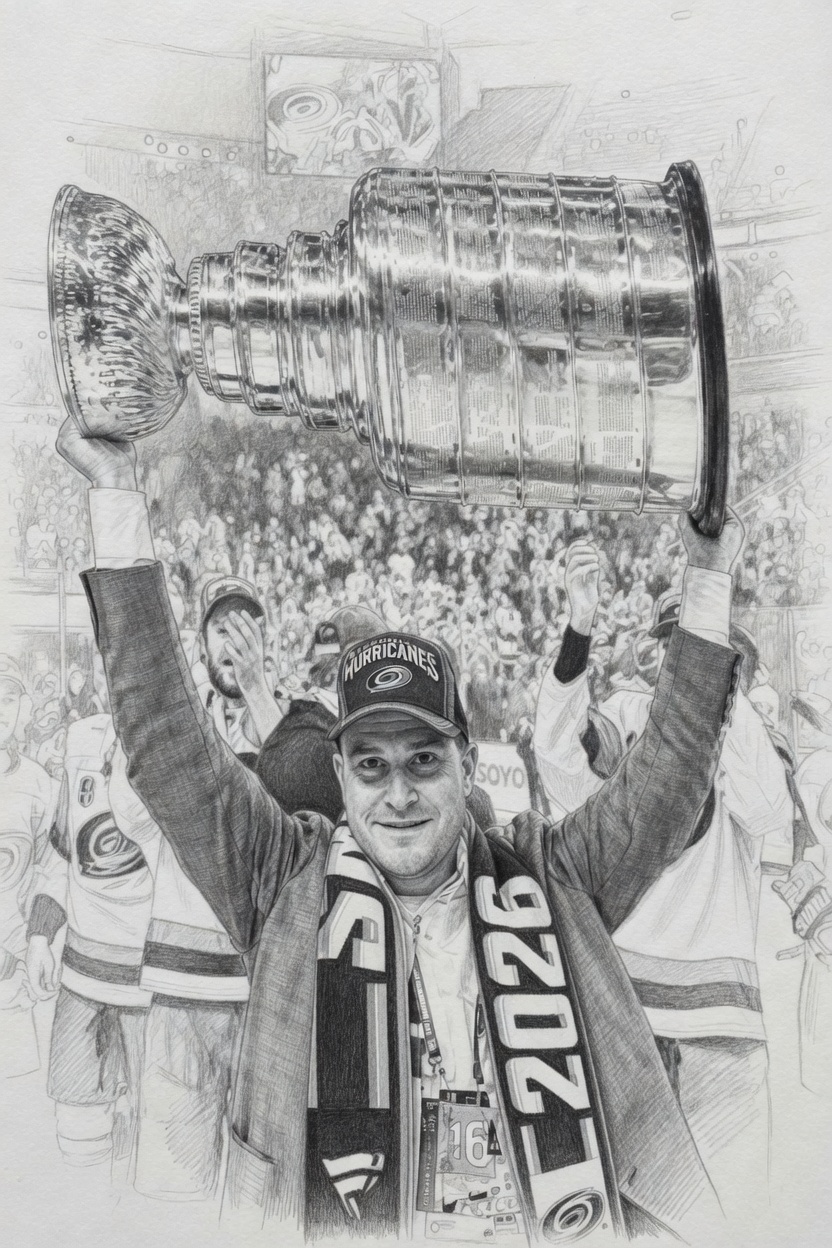
Much has been written about the 2026 Stanley Cup champion Carolina Hurricanes and their unusual front office. General manager Eric Tulsky is an old hockey blogger, as is assistant general manager Tyler Dellow. Several people who were 20 years ago called basement-dwelling hacks will now receive Stanley Cup rings. Three of them, Dellow and scouts Dennis King and Ellen Etchingham, are familiar names to old Edmonton Oilers bloggers like me. Of all their achievements, getting Oilers fans to cheer for Literally the Carolina Hurricanes may have been the most improbable.
If you want to read about this winning combination of big-brained analytics and big-bodied athletic excellence, Greg Wyshynski has written that article. The statistics revolution that came out of hockey blogs in the beginning of the century, a disproportionate number of whom were fans of the Oilers, is worth a book more than an article, but that can probably only be written once they are no longer working for pro hockey front offices and may again shoot their mouths off. To be an Oilers fan active online in the 2000s was more like the stereotype of attending a great university than any university I’ve been to: it was surrounded by people who, as a matter of course, without making a big deal about it, were changing how the hockey world thought and operated. Even for those of us who were not really contributors, it is in hindsight amazing to have been part of it: like going down to the pub with the mates and discovering 20 years later that you were hanging around the Inklings.
Setting aside the revolutionary concepts, there is now a new record for the best writer, in fact the best few writers, to win a Stanley Cup. Sadly, if you weren’t there you have to take my word for this, because these great writers wrote excellent prose on blogs that are now, by and large, offline. You can dig through the Internet Archive for bits of it, but there is no corpus, no The Hot Oil Hockey Abstract for $5 at the used bookstore. But do take my word: the reason these men and women attained a following with nothing more than their keyboards was that they made complicated, controversial concepts understandable, readable, and eventually inevitable to anybody who could approach them with a slightly open mind. They write well. That your Tulskys, your Dellows, your Kings, your Etchinghams (to name only a few of the Hurricanes) are successful in the NHL is fantastic in every way except that now we civilians no longer see what they can do. Only the bad things on the Internet last forever; good ones vanish within the lifetimes of the people who made them.
The previous, and probably still the canonical, Best Stanley Cup Champion Writer is Ken Dryden, whose The Game has been in print for more than thirty years and is still hallowed among the sort of person who hallows that sort of thing. Dryden was, in every way, more of what you expect a hockey writer to be. He did not get into the game because of his writing; he got into the game and afterwards he wrote about it. The Game stands out because, up until the blog revolution, most hockey writing was fairly bad. You had a dichotomy between journalists, who were sometimes decent writers but obviously never won, and athletes, who could be winners but when it came time to write dictated their memoirs over a few bottles of wine to one of the journalists. Such mailed-in memoirs can rise to the level of “pretty good.” Dryden was distinguished by the fact that he cared about writing himself, and had a talent for it.
We naturally lean into the idea that there are two types of people, jocks and nerds. Wyshynski’s article riffed on it, and when comparing Eric Tulsky to Rod Brind’Amour anybody would. However, the high school stereotype of the “jock” as a cemented-headed moron is one that no healthy individual can carry much beyond high school. Ex-elite athletes in team sports, taken all in all, are probably more interesting and better storytellers than the general population, for elite team play selects for brains and the ability to make people like you. That’s not a rule, but it’s a surprisingly accurate guide.
Other sports have produced a bevy of first-class athlete writers. Here is one stereotype that seems to hold up: the slower the sport, the better the writer-athletes become. Adventurers, explorers, and the like are frequently excellent writers, because boy they have time. First-class cricket, where a match lasts a few days, once got most of its greatest writers from its former players. Neville Cardus stood out for being an exception to the rule. Baseball, which is quicker than cricket but a lot slower than hockey, has also produced its share. The great baseball memoir, Jim Bouton’s Ball Four, was written by a player who wasn’t much but did win a World Series ring with the 1962 Yankees. Several baseball managers, all Jocks with the capital J, wrote well-regarded books. If you called Leo Durocher or Earl Weaver a nerd they’d bust your teeth in, but their books are still read long after their managerial insights have fallen from the state of the art.
Our hockey-bloggers-turned-champions are more like Bill James, not only a great statistician but maybe the greatest baseball writer of all, who made so much excellence for so long he just had to go win a few World Series rings in the Boston Red Sox front office. Some of those Hurricanes nerds were actually good hockey players by normal standards, but not pros. However, they are separate from James, and more like Dryden, in that if writing was ever what they did for a living, it wasn’t much of a living and it wasn’t for long.
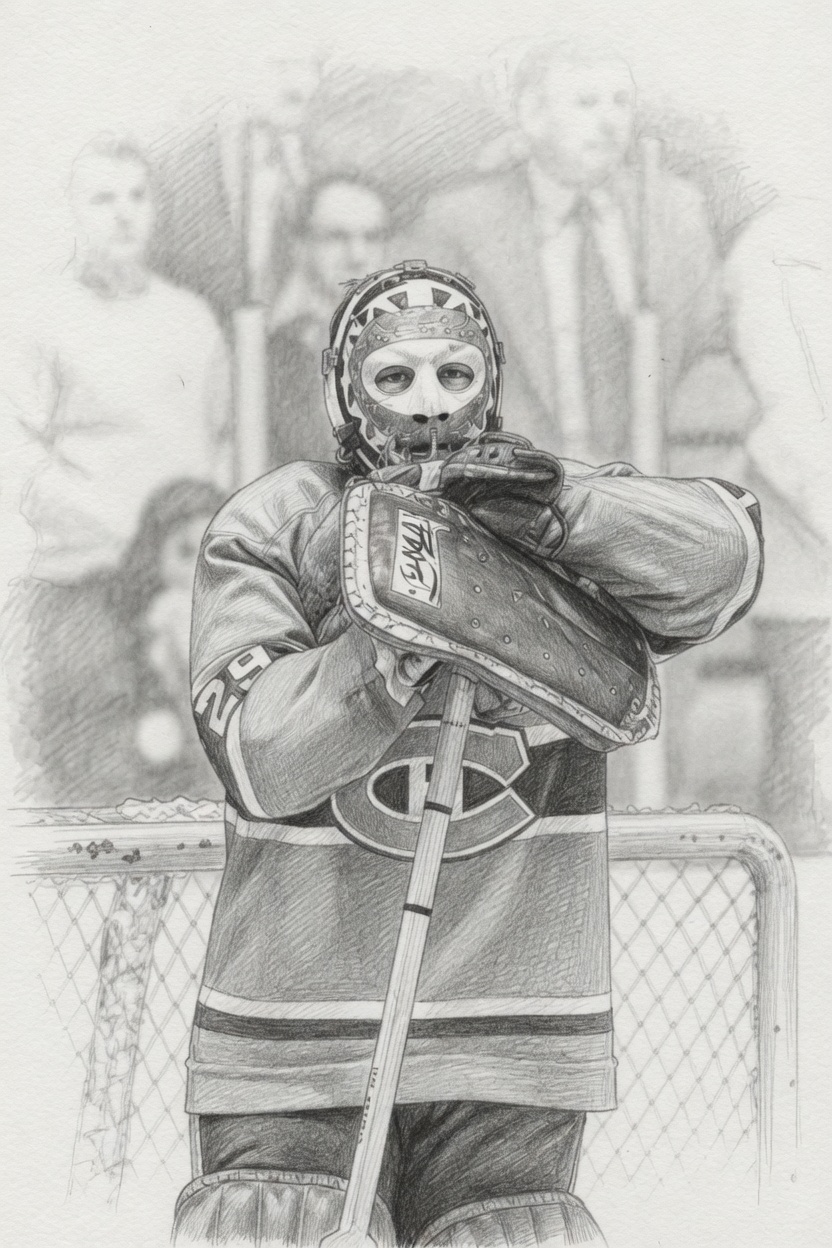
As an athlete Dryden was unusual, and while he might say that he projected the image of being unusual, some of it was objectively true. He loved hockey, but he never really seemed to like it, and quit for good very near the top of his game. A man who’d play for free, but once he got paid took it not only as a business but a disagreeable one. In the grand old days of amateur sport, Dryden could have been the amateur par excellence, but the tradition of adult, elite amateur sport was never as sturdy an edifice in Canada as it had been in England. Dryden did his best, playing college hockey at an Ivy League school. He went pro before completing the full four years, but got a degree from McGill while playing with the Canadiens, and while holding out for an entire season he pursued law, one of quite few men to lose money by becoming a lawyer. His famous pose, upright leaning on his goalie stick with both hands, has been immortalized in countless prints and a statue in Saint-Laurent; he looked like he was thinking about something else.
In the end Dryden had his cake and ate it: won Cups, made the Hall of Fame, is universally regarded as one of the best goalies in hockey history, wrote a best-seller, became a Cabinet minister, and died garlanded in laurels from the cultural and economic elite. That Dryden was an excellent goalie, give-or-take the 1972 Summit Series, is indisputable. And it is a fact that, up until bloggers started getting rings, Dryden probably deserved his reputation as the man who best combined literary excellence with knowing how to win at hockey.
It is not at all that Dryden was a bad writer, or The Game is a bad book. Reading it for the first time in many years, I was surprised how much I enjoyed it. But it can be a slog, because you see how hard Dryden is trying to Be a Real Writer. He worked hard, extremely hard, to be a great goaltender, and he never really looked like it. He worked hard, extremely hard, to write a great hockey book, and boy you can tell. The attempts to draw his teammates into characters, the digressions about Montreal politics, the attempt at off-the-cuff literary and scholarly references that do not come across off-the-cuff in the least; you never quite flinch, but it is as natural and unforced as water running uphill or the California Seals putting eight goals past him.
There are so many lines, or rather half-lines, that are good enough to see what the fuss is about:
Although I must have seen [Larry Robinson] in two training camps before, I have no memory of him until his first NHL game in Minnesota1. It was early January 1973, and with injuries to many of our defensemen, Robinson was called up from the Voyageurs. When I walked into the dressing room before the game, there he was, already half dressed, looking taller, more rawboned, more angular than he does now. With our defense depleted, seeing Robinson didn’t make me feel any better. But he played a remarkable game, poised, in solid control defensively, moving surprisingly well, with only a hint of lanky awkwardness. And what I recall most vividly, a goalie’s memory, was that he blocked shots. (It wouldn’t last long. After the first burst of rookie’s enthusiasm wore off, he became like the rest.)2
Great analysis. What I remember was how it seemed Dryden being a goalie was a complete accident of fate. Very little on practice, his dedication, his choices before the NHL, etc. , which probably was the most important part of his young life.
Brett Hull’s ghostwritten auto was the worst for this, the first few chapters you wonder how he didn’t die.