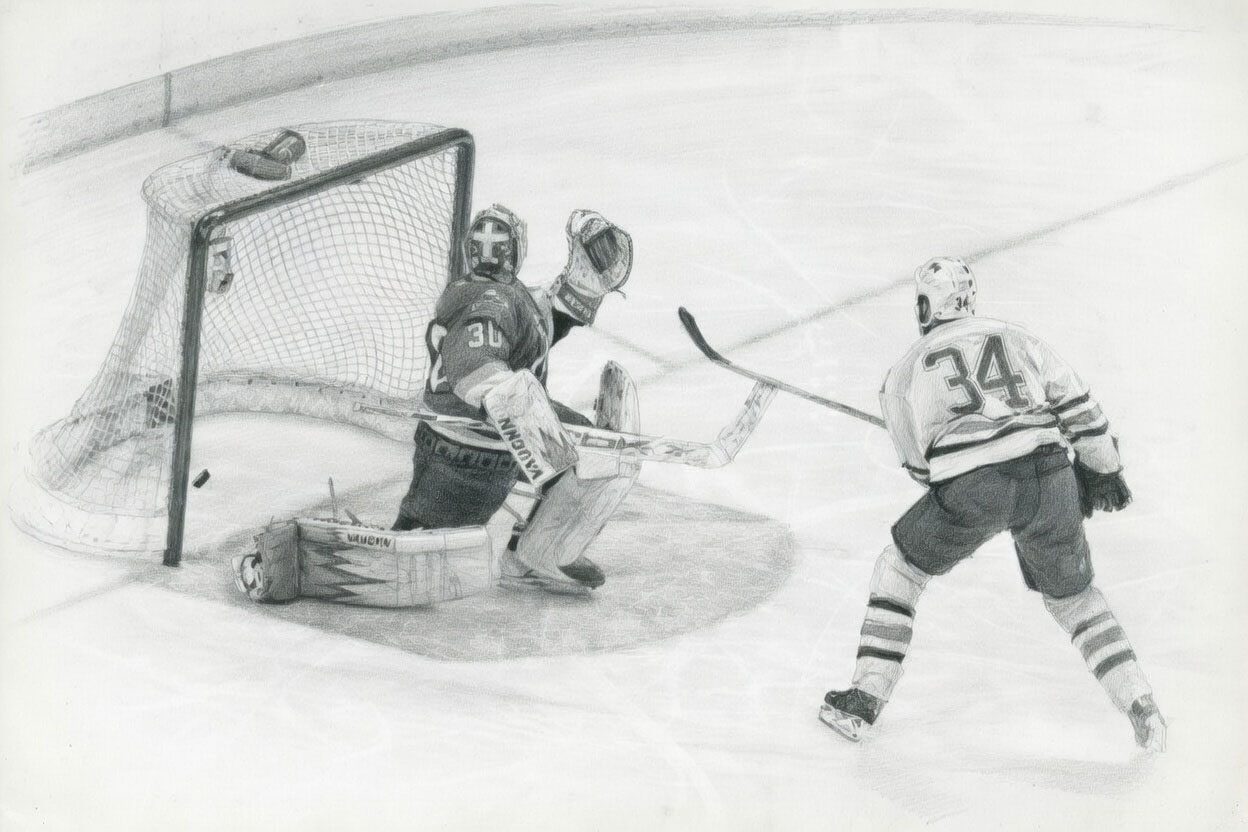
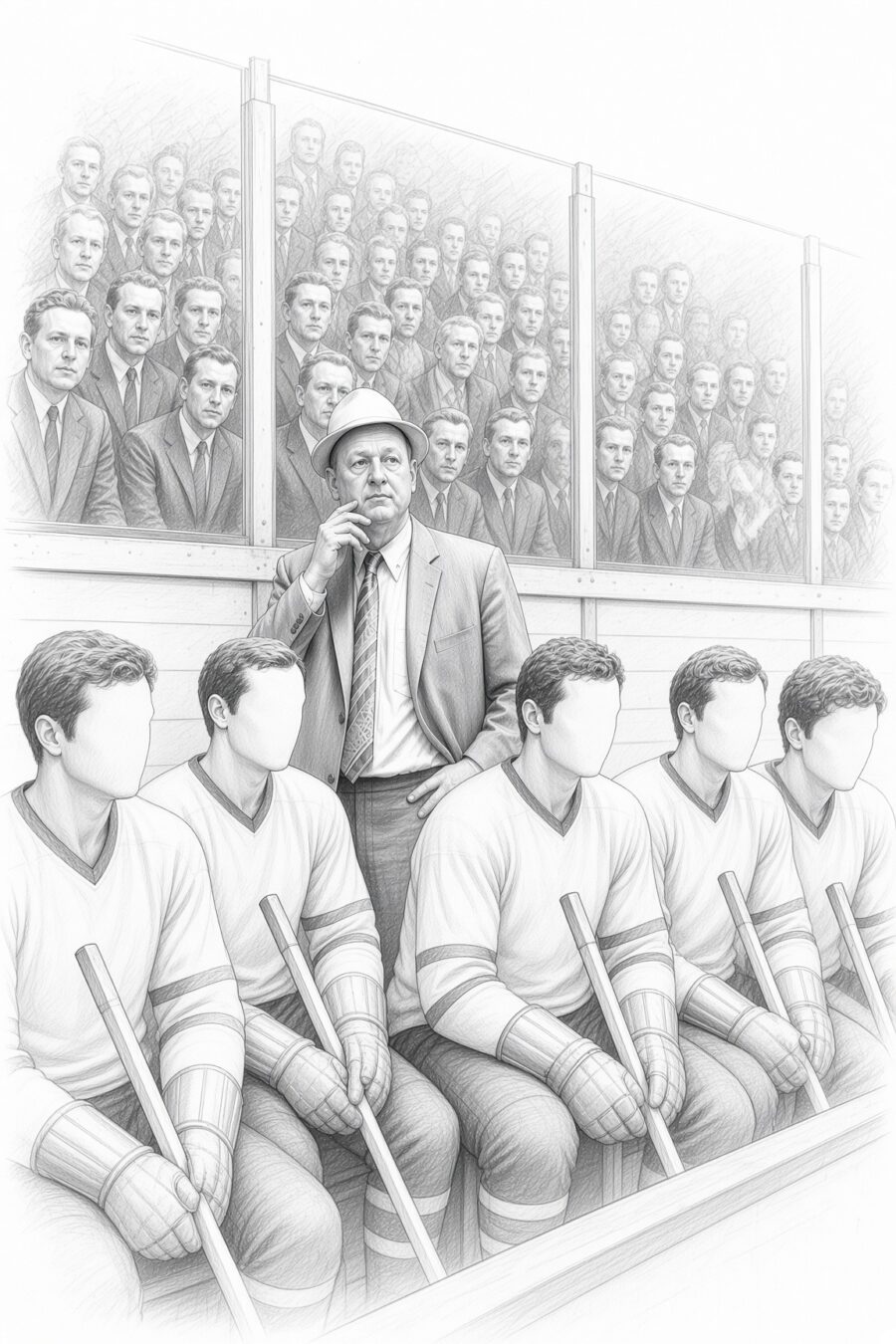
Punch Imlach must be the worst great coach in hockey history—or the greatest terrible coach. Good luck picking. We associate him with surliness and victory, and Dave Keon could tell you how well Punch played the “ruthless win-at-all-costs loyalty-free bastard” game, but Imlach also drove Frank Mahovlich out of town when he was one of the best forwards in hockey, convinced prime Carl Brewer to return to amateur hockey, and gave up on enough talent that the Leafs could have been the Habs. He built the second-best of the 1960s expansion teams, the Buffalo Sabres, but the difference between second and first was a long way. As surely as Imlach whiped the last championship Toronto Maple Leafs across the line, he also set the tone for the great underachieving Leafs of three generations: teams which knew better than to give their best because whatever they did, the cobra could turn and strike. Teams with plenty of money and talent and an underlying suspicion, so long as you punched problems like Tie Domi or did not presume to be too talented, this was a pretty soft gig.
Some men make hard, unpopular decisions because they would rather win than play favourites. Punch Imlach was not that man. Few were more passionate than Punch Imlach, and few held to their favourites with more tenacity. The number of miles he tried to ride out of Dick Duff, Eddie Shack, or Floyd Smith long after it was time to put them down blows the mind. He took those guys to the Sabres and it didn’t work, except for the troublesome fact that it kind of did: it was a team that could never win a title but was, for a hot minute, better than it had any right to be. And the Leafs? So what if Johnny Bower was 75 years old and had pleurisy; he led the league in save percentage three times in his forties. Tim Horton got his license in a Model T, and Allan Stanley was somehow older, and unbelievably it worked exactly well enough.
And he won. He won in the Original Six, but they don’t repossess the pennants just because 26 more teams came later. He won more than any other coach of his era who wasn’t Toe Blake, and the Habs were almost a special case. You couldn’t exactly say he won in Buffalo, but he definitely did not bad. He is the best Leafs’ coach since the Second World War and maybe the best Sabres coach ever. Everyone blames Harold Ballard for what happened in Toronto, but old Harold’s been dead for almost 40 years and his idea of hockey looks a lot like Punch Imlach’s. Some people, even when they seem to know everything about the game, can’t get teams to win, and some, even when they seem insane, overachieve for longer than seems possible.
The crowning glory of Imlach’s coaching career was the 1967 Toronto Maple Leafs. 1967 lives more as a meme than as a team, because nobody who isn’t a Leafs fan will ever want to give the Leafs any credit and nobody who is a Leafs fan wants to spend much time thinking about 1967.
1967 had an unusual number of old players on defense, but at forward the usual laws of hockey physics reigned. The league-leading Black Hawks, for example, counted on 26-year-old Stan Mikita, 28-year-old Bobby Hull, and 24-year-old Phil Esposito. Their defensive star was 35-year-old Pierre Pilote, but 26-year-old Pat Stapleton was coming up and most of their (excellent) depth players were the mid/late-20s ascending talent you’d expect: Dennis Hull (22), Chico Maki (27), Ken Hodge (22), Doug Jarrett (22). In goal, Glenn Hall (35) played fewer games than Denis DeJordy (28, and I might add who?), though with a team that good you could put the Shooter Tutor in net and win 40 games. Which the Black Hawks did, or to be specific 41 wins, 17 losses, and 12 ties.
“Everyone knows” the Habs were always old, and indeed Jean Beliveau was 35. But he was grey-haired elegance by then, paid to be Jean Beliveau. Henri Richard, still excellent, was 30, and once you took the Pocket Rocket out the play ran through late-20s players like John Ferguson, Ralph Backstrom, and J. C. Tremblay, plus a 24-year-old Roadrunner. The depth wasn’t young, but couldn’t get the seniors’ discount on their dance contact yet. In goal they averaged out to average but should probably be described as “miscellaneous.” Rogie Vachon (21) represented youth and Gump Worsley (37) experience, so Charlie Hodge (33) got a plurality of the games as old Toe picked his tendie based on vibes, astrology, and how Gump’s rheumatism felt. Rogie was the best of the bunch; Toe only figured that out fairly late in the season, but once he did he had the gumption (so to speak) to stick with Vachon in the playoffs, which was a bold decision at the time.
The Hawks were in their prime. The Canadiens were not young. The Leafs, third in the six-team NHL during the regular season, were old. Dave Keon and Frank Mahovlich, two of their three leading players, were at their best, but since those are the two most famous Punch Imlach alienation cases of all this was a mixed advantage. Red Kelly, probably the team MVP, was 39. Tim Horton was 37. George Armstrong captained the team and played 70 games because I guess somebody had to; he was 36. They dragged 36-year-old Marcel Pronovost, a thoroughbred with laminitis if there ever was one, out there for 58 games, which was probably too many. Moving down the depth chart, Bobby Baun was 30. Kent Douglas was 30. Bob Pulford was 30. Allan Stanley was 40. They had Ron Ellis, at 22, who was legitimately a good young player, and Pete Stemkowski, at 23, who was arguably a young player, and not much else. In goal, because 48 of 70 games were started by either Johnny Bower (42) or Terry Sawchuk (37), everyone forgets about Bruce Gamble (28). Also because Bruce Gamble (28) was Bruce Gamble (28), and so dramatically inferior to the old guys that one mark against “Punch Imlach loved old players” is that he forgot himself enough to start Bruce Gamble twenty times. They also got cameos from the Smiths Gary and Al, who would go on to become solid starters, but neither was ready in 1967.
The Rangers, Bruins, and Red Wings were also in the league. For the Bruins, Bobby Orr had just turned up so the tea party was obviously coming, but the Rags and the Dead Things were just sort of there because the Habs and Hawks had to play somebody. Being in the Original Six might have been an easier path to glory, but it was no sure thing.
Toronto, though old, had a veteran savvy that surely led them to success, which is why we’re talking about them. Well, erm, kinda. Third in a six-team NHL, you will realize, is pretty mid. They had a negative goal difference. Over a relatively small number of games Bower was probably the best goalie in the league, but he was so old and so banged up that he won fewer games above replacement than New York’s Ed Giacomin. Sawchuk was actually very good too, but he was getting old and not something to rely on either, and Gamble sucked. It’s a good thing that Bower and Sawchuk were good, because their defense wasn’t: even allowing for the great save percentages of the nursing home duo Toronto was still fourth in the league in goals against (admittedly, fifth and sixth were practically in another league, and sixth had Bobby Orr). Horton was tough as nails but drank too much and couldn’t see, Stanley was old as Moses but couldn’t most things, Pronovost was a sack of bones and guts, a great defenseman on his day who was five years past it. Larry Hillman was Hall of Okay, first-ballot. Kent Douglas was a textbook Punch Imlach player, a hard-pounding defensive defenseman who Imlach somehow contrived to dislike, Jim McKenny had most of Horton’s drinking problem without Horton’s almost memetic solidity, the rest of the defense was somehow even worse.
To indulge in another nominative pun, the punchline is that the 1967 Leafs didn’t score either. Red Kelly’s move from defense to centre was one of the all-time great strikes of coaching intuition. As a forward, Kelly looks in hindsight a bit like the talking horse: the surprise is not that he did it well, but that he did it at all. He was old as a defenseman, he was done, and under Imlach he was a centre you were darned glad to have on playoff teams. Kelly was certainly a key player, one who you wanted; at this stage you were not entirely happy if he was your MVP.
Of those who didn’t remember the Depression, Keon and the Big M were fantastic, and Bob Pulford was a capable accompanist, an underrated and quality player. Ron Ellis would never reach the Mahovlich class, but was still definitely very good. No complaints about those five, but you like to have no complaints about more than five forwards on your Stanley Cup champions, particularly not when Bobby Hull and Stan Mikita and Phil Esposito are lighting it up within sight of Sarnia with Pierre Pilote and Pat Stapleton on the blueline and Glenn Hall in net.
It was those Black Hawks that Toronto met in the first round of the playoffs, because in those days seeding felt less important; 1 faced 3 and 2 faced 4 so they could get on to the show in the final.
I felt obliged to enter a paragraph break for emphasis. The story, mental as it sounds, is that Punch was determined to make his Leafs outhustle a Black Hawks team that was much younger, quicker, more talented, and frankly much better than his. The Leafs went to the old Peterborough arena and Imlach put the Over-the-Hill Gang through a high-intensity, backbreakingly brutal regimen better suited for a junior team that had lost nine in a row. After a few days of bag skates and full-speed drills the seniors were puking and angry just in time for Game One at Chicago Stadium. Mad as hell, but not sure who with, the Leafs promptly took a dumb cross-checking penalty and went down 1-0. The Big M tied it up, and with the game in the balance Bob Pulford picked a stick fight with Whitey Stapleton. Whitey took the misconduct but the ensuing 4-on-4 made the Leafs look very old indeed; Pierre Pilote got the goal to put Chicago back on top. From then on Chicago was comfortable. After Bobby Hull and Mikita made it 4-1 the Leafs were able to pepper Denis DeJordy with shots, fat lot of good it did, and Jim Pappin’s consolation goal just made Toronto lose 5-2. Punch Imlach was the dumbest man in hockey.
Jim Pappin. There was a man with a very strange career. From the moment he broke in with the Leafs in 1963, he had obvious talent. He was a Punch Imlach player in every way except one. He was tough, gritty, and knew his way around in front of the goal. His one flaw was that Imlach did not love him. The feeling was mutual, and if Pappin had been less fortunate it would have killed his career. After bouncing between the Leafs and the minors for most of his twenties Pappin became a Chicago Black Hawk at age 29, where he posted a few 70-point seasons and a 93; with Toronto, his career high was 32.
Pappin was, then, another victim of Imlach’s arbitrariness and cantankerousness. Except that without Imlach, Pappin never would have won a Stanley Cup, and without Pappin, Imlach never would have won in 1967. As a Black Hawk, Pappin played all the time, put up points, and didn’t win anything; as a Leaf, Pappin was lucky to get his contract paid out as agreed and won it all. But Pappin cared so little about having won in 1967 that he gave his Stanley Cup ring to his father-in-law, who lost it on the beach; being appreciated in Chicago meant much more to him. That was life playing under Punch Imlach.
If we circle back to the first paragraph, and you twist my arm, I’ll own up: Punch Imlach was a great coach. Not just because he won, but because of how he won. With the Leafs smashed to pieces in game one, with the players exhausted, elderly, and mad, Imlach paid attention. The bag skates stopped and the veterans were trusted to find their way. Assistant coach King Clancy was high on a second line of Pulford, Stemkowski, and Pappin; Imlach gave them their head. Chicago coach Billy Reay couldn’t reconcile himself to old Glenn Hall in goal and used Denis DeJordy to start the playoffs; Imlach obviously wished Bruce Gamble could play but since he couldn’t out went Terry Sawchuk. Toronto won Game Two 3-1. The “Clancy Line” of Pulford-Stemkowski-Pappin combined on the first goal and Dave Keon got a shortie just before the end of the first. Yet Imlach got a return on his peculiarly Punchian instincts too: George Armstrong, who looked so ineffective all season, played regularly on special teams and had a shorthanded assist and a power play goal. Chicago outshot Toronto 34-25 but Sawchuk buried DeJordy. Series tied.
On April 11, the Hawks finally started Hall at Maple Leaf Gardens, but in a real sense they had already lost their chance. The Leafs had stuck it to their loathsome old fat fedoraed coach and won it their way; the Hawks were just humans after all. Game Three was tight but Ellis, Mahovlich, and Pappin chipped away at Hall while everybody in the rink knew Sawchuk would allow a goal only if he physically had to. The shots were about even and the Leafs won 3-1 with both goalies playing well; nobody had stolen anything from anyone and the Leafs won handily anyway. Chicago won Game Four in a whipsaw game which could have gone either way up until the last minute, and while Chicago’s superior skill was evident in hindsight I’m not sure it would have felt that way in the rink. Then came Game Five.
I am a Toronto Maple Leafs hater. Every Stanley Cup the Maple Leafs won is one too many. This is the editorial context here. The Hawks, frankly, had no nerve. Billy Reay couldn’t decide between Hall and DeJordy, and viewed 60 years later that looks like not being able to decide between a diamond ring and a Flokati rug. Reay was obviously a smart guy. He coached in sixteen NHL seasons, mostly for talented organizations, and never won anything.
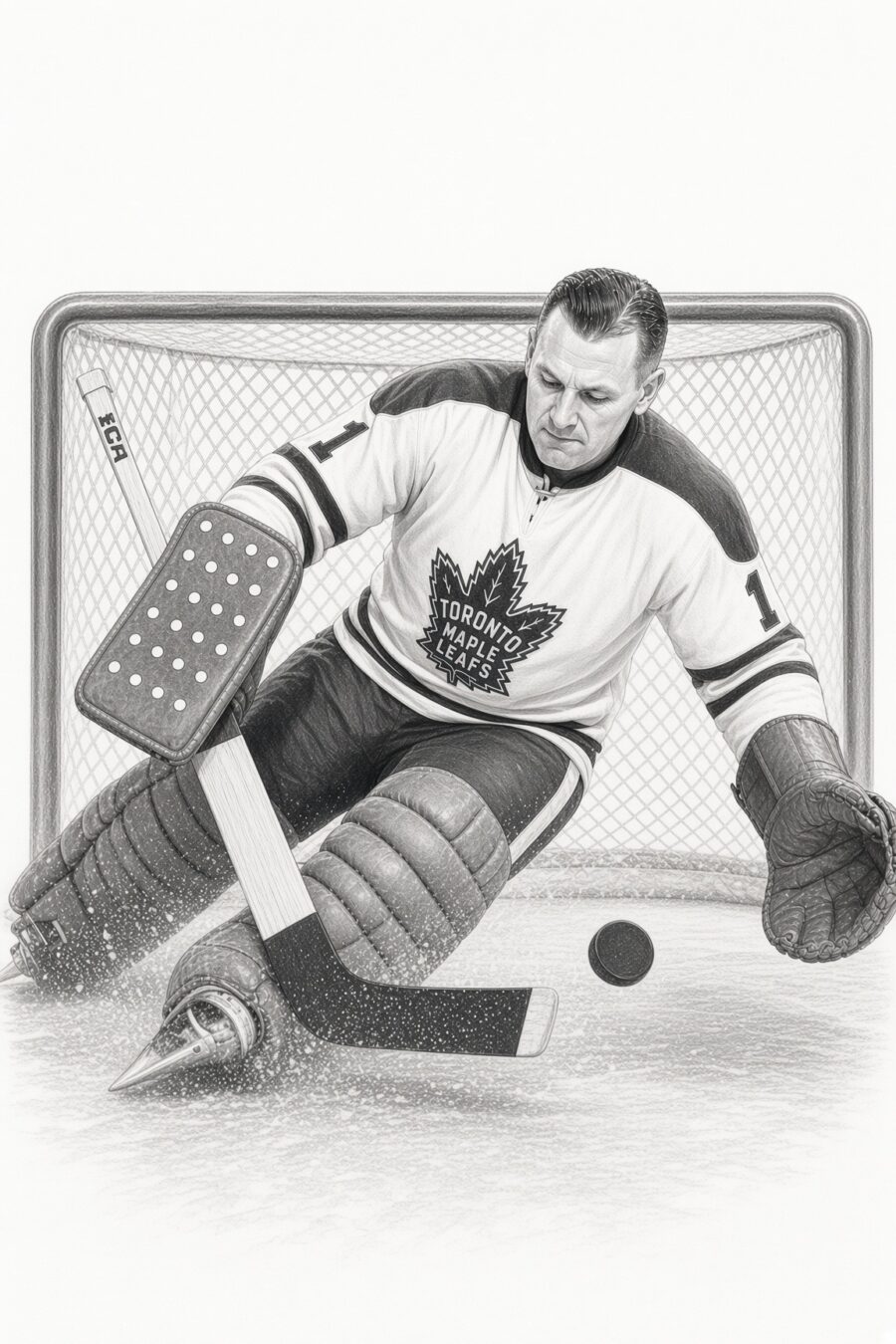
Anyway, Reay desperately wanted DeJordy, and out he came for Game Five. Sawchuk was a no-brainer for Punch, and so out came… Johnny Bower, supposedly recovered from a lingering finger injury. Bower had had a great regular season, but was hardly reliable at this stage, whereas Sawchuk was younger (if still old), had an even better pedigree, and had been lights-out.
You have to be good to be lucky, and lucky to be good. The Leafs played great in the first, apart from Bower. In a chippy game, Mike Walton and the Big M scored powerplay goals, but Lou Angotti and Bobby had even strength goals for Chicago and in a period Toronto should have probably have led, it was a 2-2 tie after twenty minutes. Bower had allowed two goals on twelve shots; not great, not terrible. You send your regular starter out for the second almost all the time in that position. It wasn’t bad enough to scream for a change, which meant a hook would be obvious panic.
“Better known for other work” 😏