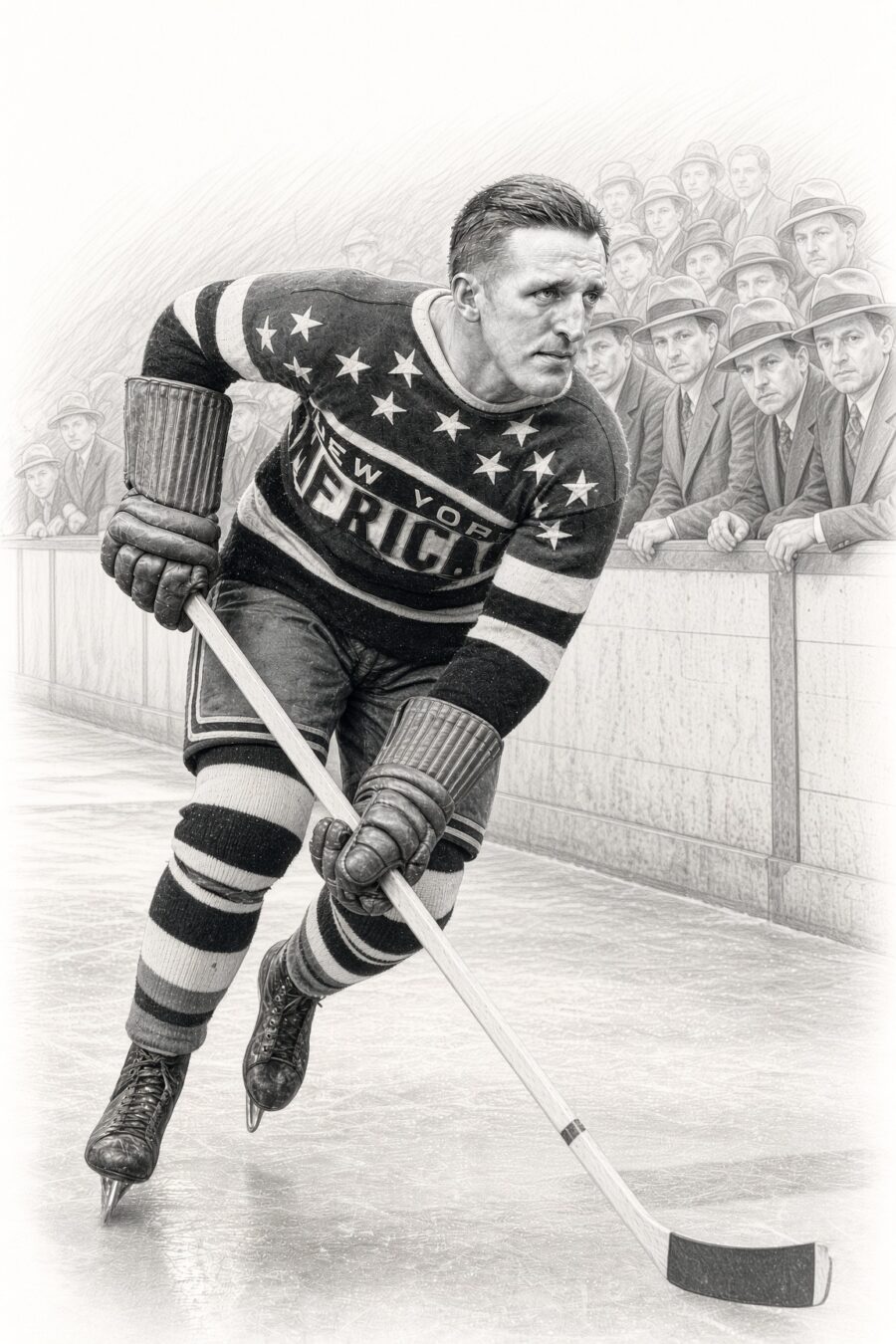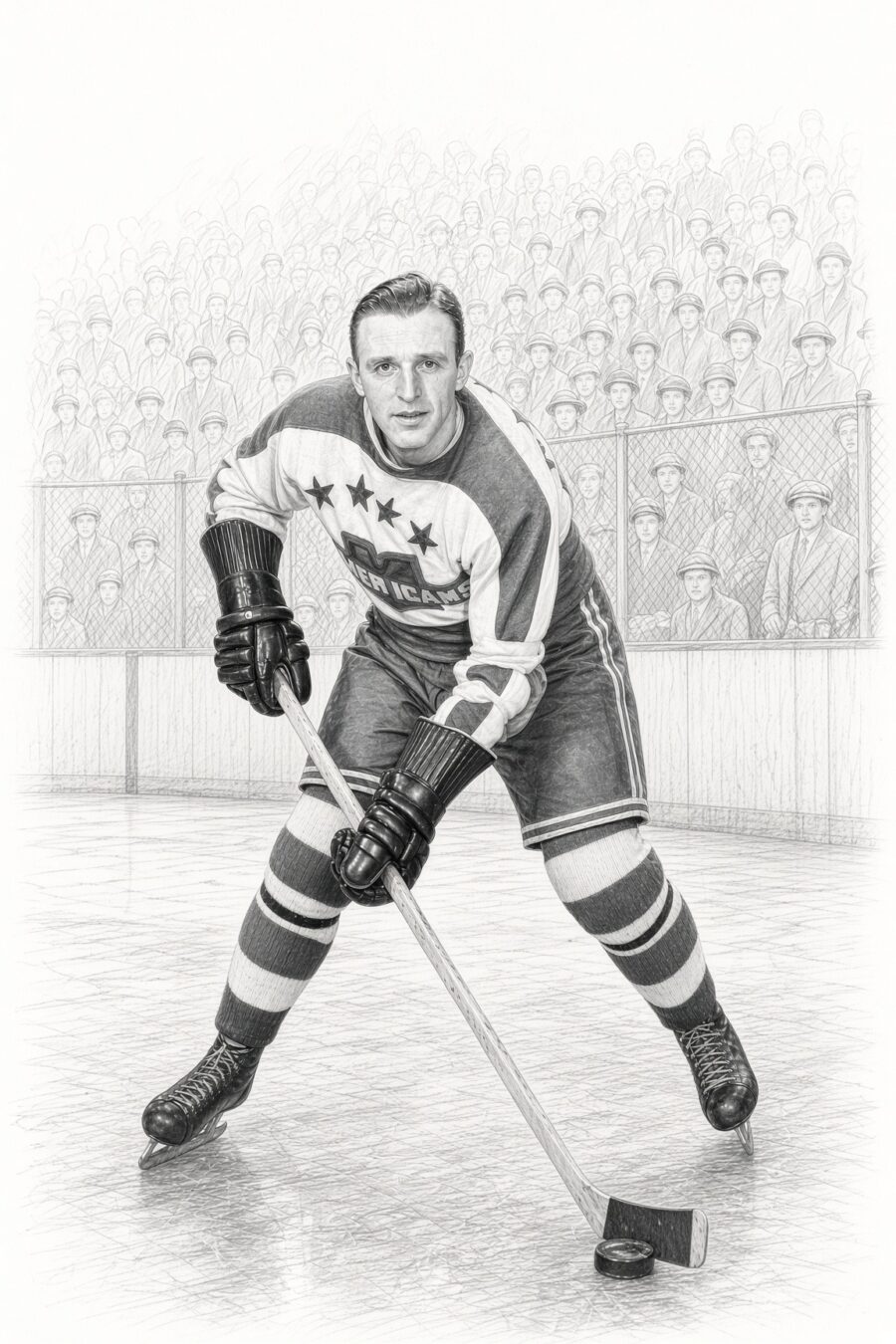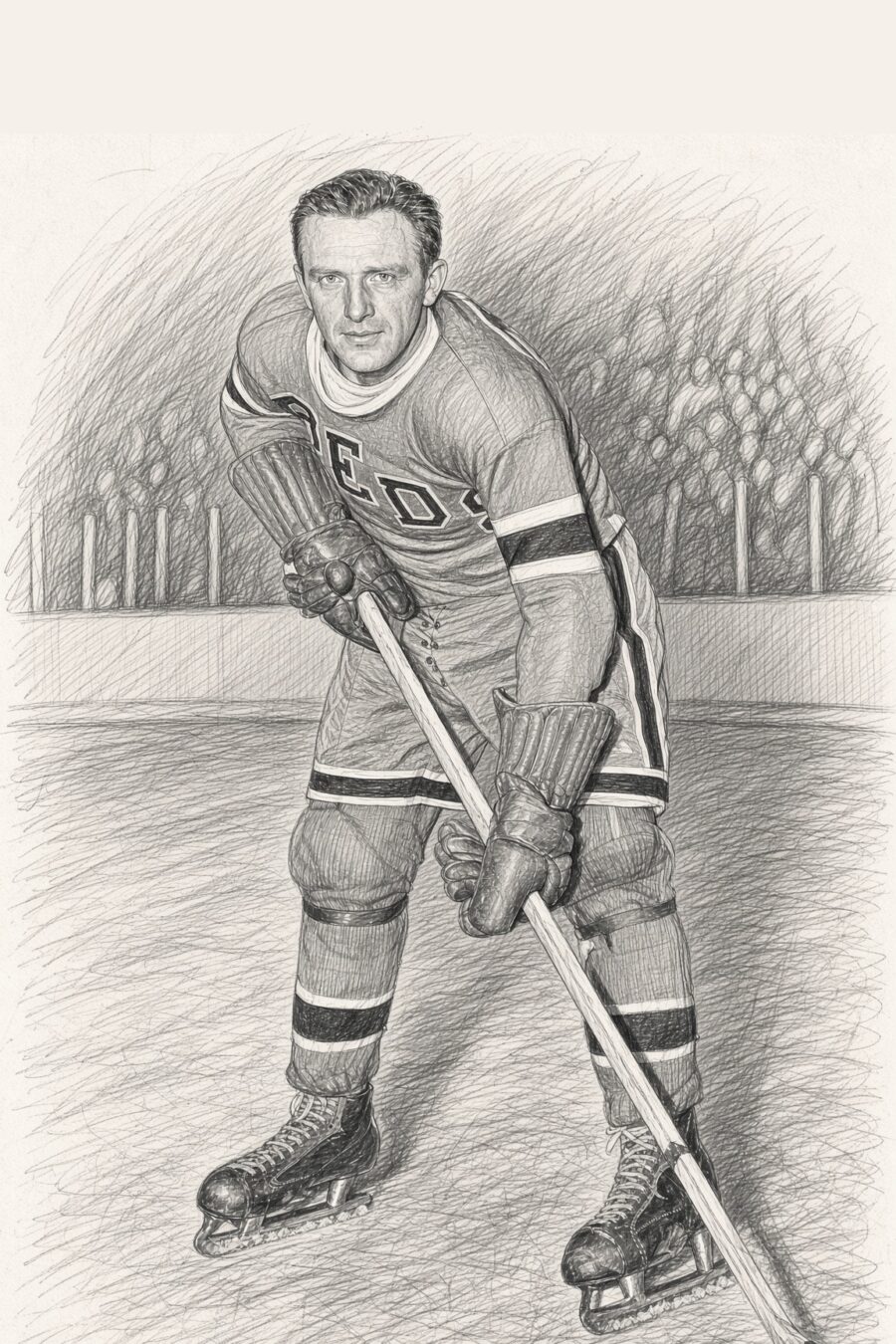
A nice trivia question: who is the only Hart Trophy winning skater eligible for the Hockey Hall of Fame who has not been selected? Answer: Tommy Anderson of the 1941–42 Brooklyn Americans. Anderson got his start as a journeyman winger who, at times, verged on the pretty good. As a forward he never led an NHL team in scoring but could occasionally come close. Then Anderson moved to defense and became, if not Bobby Orr, at least Brad Park for a day. In 1941–42 Anderson scored a record 41 points from the blue line, won the Hart almost naturally, and never played big-league hockey again.
It was the most improbable of Hart Trophy seasons, but there was far more to Anderson than his one great season or even his otherwise-modest NHL career. For all its strange turns, Anderson’s career summarized an era of hockey that has almost passed from living memory.
Born in Edinburgh, Anderson emigrated to Calgary with his family as a toddler, then moved to nearby(-ish) Drumheller as a child.1 Anderson was something of a local phenom. Nicknamed “Cowboy,” especially locally, Anderson turned out for the Drumheller CNR junior team alongside his brother Liston. In one memorable game, the Anderson family played the Drumheller juniors minus Tommy and Liston. With their father Alex, who allegedly had never been on skates before, in goal, the Andersons beat their junior teammates 5-4.2 By December 1929 the 19-year-old Anderson was described as “the idol of the fans all of last season,” which seems justified, and “a speedy skater,” which perhaps does not.3
Thanks in part to Anderson’s eight goals4 the Miners made it to the southern Alberta senior final, where they lost to the Calgary Bronks.5 In the season-ending awards it was Connie King, a year and a half older than Anderson, who was named team MVP ahead of Anderson, winning a $50 watch, while Anderson won a spring coat as first runner-up;6 this did no harm to his career, as both Anderson and King were signed by the Philadelphia Arrows that summer, a coup which was front-page news in Drumheller.7
You wouldn’t have picked Anderson out as a Hart winner. Both Drumheller alumni started their pro careers as depth players, but in their second season King led the Arrows in scoring while Anderson was down in seventh on a mediocre team. In 1932–33 King moved to New England for a season and Anderson was the Arrows’ third-leading scorer behind NHL journeyman Paul Runge and Irwin Boyd, nicknamed “Yank” because he managed the rare feat of actually being from Philadelphia. King returned to Philadelphia for 1933–34, and in his fourth minor pro season, Anderson at last stood out, tying with King for the team and league scoring lead on 45 points.8 Despite this scoring battery the Arrows finished only 17-15-8 and lost in the first round of the playoffs. At age 23 Anderson was at last ready to graduate from the Can-Am.
The rights to Anderson, King, and “Yank” Boyd were all picked up by the Detroit Red Wings for the 1934–35 season.9 King spent a couple years in the Red Wings’ minor league system but never played in Detroit, or indeed anywhere else in the NHL. Boyd, who had played 30 undistinguished games with the Boston Bruins a few years earlier, got 42 more then went back to the minors until the Second World War gave him a couple cameos in his mid-thirties.10 For the second time, Anderson stuck around at a higher level without setting the world aflame. His seven points in 27 games came ninth on the mediocre Red Wings, and a good deal better than Boyd’s five in 40, but probably nobody was looking to Anderson as a star of the future. Jack Adams certainly wasn’t. Anderson spent a third of the season in the minors (where his 13 points in 15 games was a good return) and was sold to the New York Americans in the offseason.
Anderson was actually the second old Drumheller Miner on the Americans, joining Fred Hergerts, who played the last of his 20 career NHL games that year. Once again, if you could pick Anderson out as a future star, you were a better scout than most: it takes a lot of scrolling to find his 5 points in 24 games on the leaderboard of a team that finished 16-25-7. But he got better, though the Amerks did not.
Red Dutton was named player-coach for 1935–36, and after another ordinarily bad campaign for the team, hung up the axe before 1936–37. New York fell to 15-29-4 but Anderson improved to 25 points in 41 games as a second-line winger with some power play time. Only in 1938–39 did Anderson, then 28 years old, seem to find himself on the first line, playing a supporting role to the superior (and younger) Sweeney Schriner. Anderson’s 40 points in 48 games was second on the team behind Schriner and tied with Hart runner-up Syl Apps for sixth in the seven-team league (though Apps played fewer games). Schriner was traded to the Maple Leafs that spring for Busher Jackson and the pu-pu platter; without him, Anderson again finished second in team scoring behind Murray Armstrong (who?!) but mustered only 31 points in 48 games. The Americans again posted a record of 15-29-4, second-last in the league above (believe it or not) the Montreal Canadiens, and Anderson tied for 13th in league scoring with Rangers journeyman Dutch Hiller.
In 1940–41 Dutton moved to a full-time front office role, replaced as coach by Art Chapman, long-time Americans centre and former Anderson linemate. It helped nobody. The Americans, now clearly tottering as a franchise, collapsed even further and Anderson contributed just 15 points in 35 games. The end was nearing for Tommy Anderson and the New York Americans alike.11
In 1939 Dutton took time to gush about Anderson to the Canadian Press. “Tommy is a manager’s player … He’s a playmaker even when he’s defending—on the move all the time … and how he moves!”12 “How he moves” can be taken one of two ways. As a rookie with the Arrows, an enthusiastic but unnamed Philadelphia newspaperman called Anderson “the fastest man to date” in training camp,13 but he didn’t keep that reputation into the majors. New York Rangers head coach Frank Boucher said Anderson “wasn’t the best skater.”14 Babe Gresko, a minor pro player, later described Anderson’s skating as choppy and bow-legged, while a newspaper account praised Anderson for “know[ing] the shortest distance between two points,” which is how you say a player is smart enough to be effective despite his skating.15 Anderson was not quite the slowest thing to come out of Drumheller since the dinosaurs, but he made his money with brains rather than legs.
It was therefore probably out of desperation that in the fall of 1941 the Americans tried their awkward-skating, intelligent, veteran winger on defense. Explained Dutton, “our roster already had been trimmed because of war enlistments. I was short on the blue line, so I figured I’d give him a try back there.”16 Of course, the Amerks’ blue line had been short for half a decade under Dutton’s management, but he wasn’t about to put it quite so baldly. Dit Clapper made that move at the same age but Dit Clapper, the power forward of his era, probably weighed one and a half Tommy Andersons and was an altogether superior player. Anderson wasn’t exactly small, and played the body well, but he did not possess the classical physical gifts of the defenseman.