Skip to content

The Strange Career and Triumph of Tommy Anderson

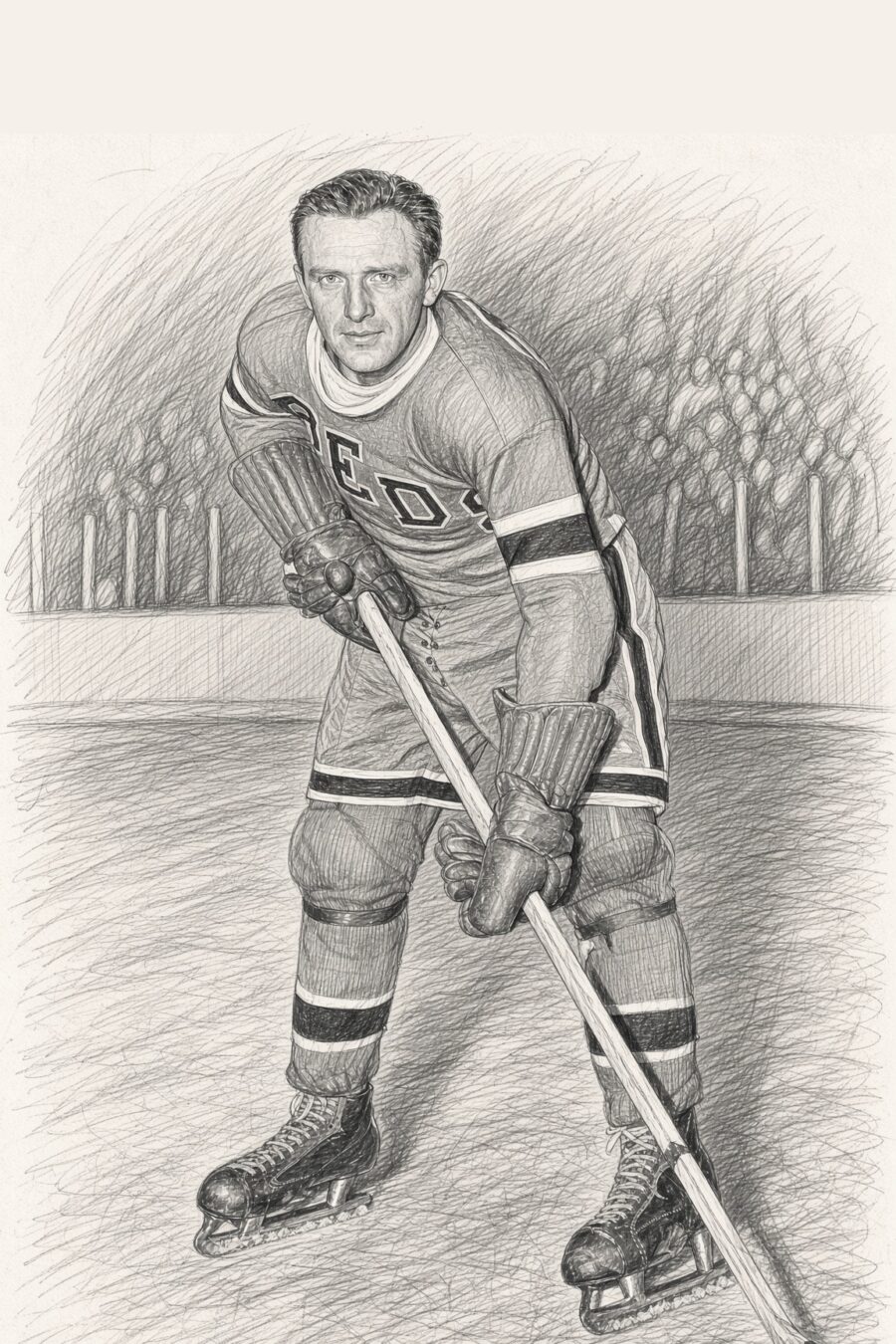
A nice trivia question: who is the only Hart Trophy winning skater eligible for the Hockey Hall of Fame who has not been selected? Answer: Tommy Anderson of the 1941–42 Brooklyn Americans. Anderson got his start as a journeyman winger who, at times, verged on the pretty good. As a forward he never led an NHL team in scoring but could occasionally come close. Then Anderson moved to defense and became, if not Bobby Orr, at least Brad Park for a day. In 1941–42 Anderson scored a record 41 points from the blue line, won the Hart almost naturally, and never played big-league hockey again.

It was the most improbable of Hart Trophy seasons, but there was far more to Anderson than his one great season or even his otherwise-modest NHL career. For all its strange turns, Anderson’s career summarized an era of hockey that has almost passed from living memory.

Born in Edinburgh, Anderson emigrated to Calgary with his family as a toddler, then moved to nearby(-ish) Drumheller as a child.1 Anderson was something of a local phenom. Nicknamed “Cowboy,” especially locally, Anderson turned out for the Drumheller CNR junior team alongside his brother Liston. In one memorable game, the Anderson family played the Drumheller juniors minus Tommy and Liston. With their father Alex, who allegedly had never been on skates before, in goal, the Andersons beat their junior teammates 5-4.2 By December 1929 the 19-year-old Anderson was described as “the idol of the fans all of last season,” which seems justified, and “a speedy skater,” which perhaps does not.3

Thanks in part to Anderson’s eight goals4 the Miners made it to the southern Alberta senior final, where they lost to the Calgary Bronks.5 In the season-ending awards it was Connie King, a year and a half older than Anderson, who was named team MVP ahead of Anderson, winning a $50 watch, while Anderson won a spring coat as first runner-up;6 this did no harm to his career, as both Anderson and King were signed by the Philadelphia Arrows that summer, a coup which was front-page news in Drumheller.7

You wouldn’t have picked Anderson out as a Hart winner. Both Drumheller alumni started their pro careers as depth players, but in their second season King led the Arrows in scoring while Anderson was down in seventh on a mediocre team. In 1932–33 King moved to New England for a season and Anderson was the Arrows’ third-leading scorer behind NHL journeyman Paul Runge and Irwin Boyd, nicknamed “Yank” because he managed the rare feat of actually being from Philadelphia. King returned to Philadelphia for 1933–34, and in his fourth minor pro season, Anderson at last stood out, tying with King for the team and league scoring lead on 45 points.8 Despite this scoring battery the Arrows finished only 17-15-8 and lost in the first round of the playoffs. At age 23 Anderson was at last ready to graduate from the Can-Am.

The rights to Anderson, King, and “Yank” Boyd were all picked up by the Detroit Red Wings for the 1934–35 season.9 King spent a couple years in the Red Wings’ minor league system but never played in Detroit, or indeed anywhere else in the NHL. Boyd, who had played 30 undistinguished games with the Boston Bruins a few years earlier, got 42 more then went back to the minors until the Second World War gave him a couple cameos in his mid-thirties.10 For the second time, Anderson stuck around at a higher level without setting the world aflame. His seven points in 27 games came ninth on the mediocre Red Wings, and a good deal better than Boyd’s five in 40, but probably nobody was looking to Anderson as a star of the future. Jack Adams certainly wasn’t. Anderson spent a third of the season in the minors (where his 13 points in 15 games was a good return) and was sold to the New York Americans in the offseason.

Anderson was actually the second old Drumheller Miner on the Americans, joining Fred Hergerts, who played the last of his 20 career NHL games that year. Once again, if you could pick Anderson out as a future star, you were a better scout than most: it takes a lot of scrolling to find his 5 points in 24 games on the leaderboard of a team that finished 16-25-7. But he got better, though the Amerks did not.

Red Dutton was named player-coach for 1935–36, and after another ordinarily bad campaign for the team, hung up the axe before 1936–37. New York fell to 15-29-4 but Anderson improved to 25 points in 41 games as a second-line winger with some power play time. Only in 1938–39 did Anderson, then 28 years old, seem to find himself on the first line, playing a supporting role to the superior (and younger) Sweeney Schriner. Anderson’s 40 points in 48 games was second on the team behind Schriner and tied with Hart runner-up Syl Apps for sixth in the seven-team league (though Apps played fewer games). Schriner was traded to the Maple Leafs that spring for Busher Jackson and the pu-pu platter; without him, Anderson again finished second in team scoring behind Murray Armstrong (who?!) but mustered only 31 points in 48 games. The Americans again posted a record of 15-29-4, second-last in the league above (believe it or not) the Montreal Canadiens, and Anderson tied for 13th in league scoring with Rangers journeyman Dutch Hiller.

In 1940–41 Dutton moved to a full-time front office role, replaced as coach by Art Chapman, long-time Americans centre and former Anderson linemate. It helped nobody. The Americans, now clearly tottering as a franchise, collapsed even further and Anderson contributed just 15 points in 35 games. The end was nearing for Tommy Anderson and the New York Americans alike.11

In 1939 Dutton took time to gush about Anderson to the Canadian Press. “Tommy is a manager’s player … He’s a playmaker even when he’s defending—on the move all the time … and how he moves!”12 “How he moves” can be taken one of two ways. As a rookie with the Arrows, an enthusiastic but unnamed Philadelphia newspaperman called Anderson “the fastest man to date” in training camp,13 but he didn’t keep that reputation into the majors. New York Rangers head coach Frank Boucher said Anderson “wasn’t the best skater.”14 Babe Gresko, a minor pro player, later described Anderson’s skating as choppy and bow-legged, while a newspaper account praised Anderson for “know[ing] the shortest distance between two points,” which is how you say a player is smart enough to be effective despite his skating.15 Anderson was not quite the slowest thing to come out of Drumheller since the dinosaurs, but he made his money with brains rather than legs.

It was therefore probably out of desperation that in the fall of 1941 the Americans tried their awkward-skating, intelligent, veteran winger on defense. Explained Dutton, “our roster already had been trimmed because of war enlistments. I was short on the blue line, so I figured I’d give him a try back there.”16 Of course, the Amerks’ blue line had been short for half a decade under Dutton’s management, but he wasn’t about to put it quite so baldly. Dit Clapper made that move at the same age but Dit Clapper, the power forward of his era, probably weighed one and a half Tommy Andersons and was an altogether superior player. Anderson wasn’t exactly small, and played the body well, but he did not possess the classical physical gifts of the defenseman.
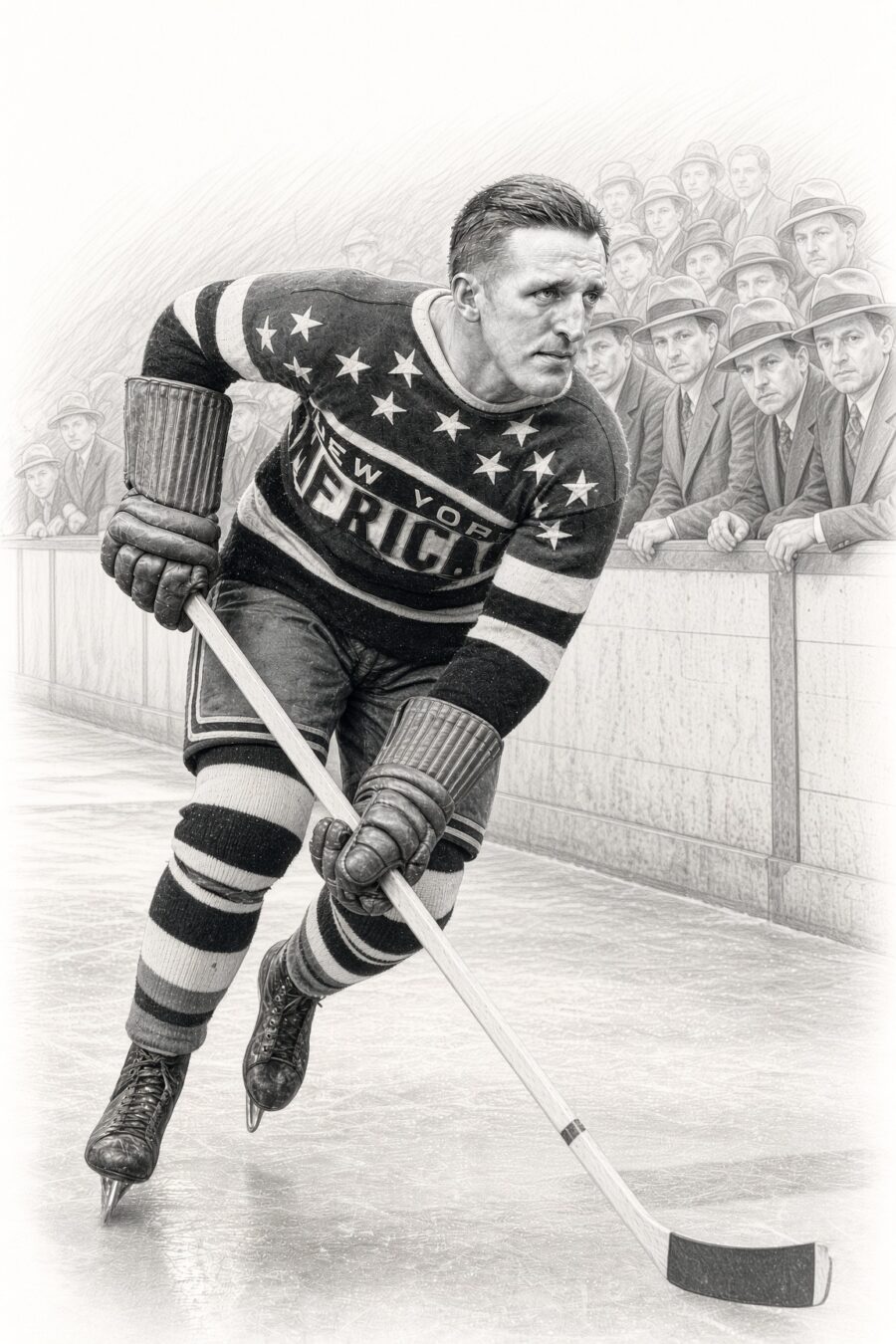
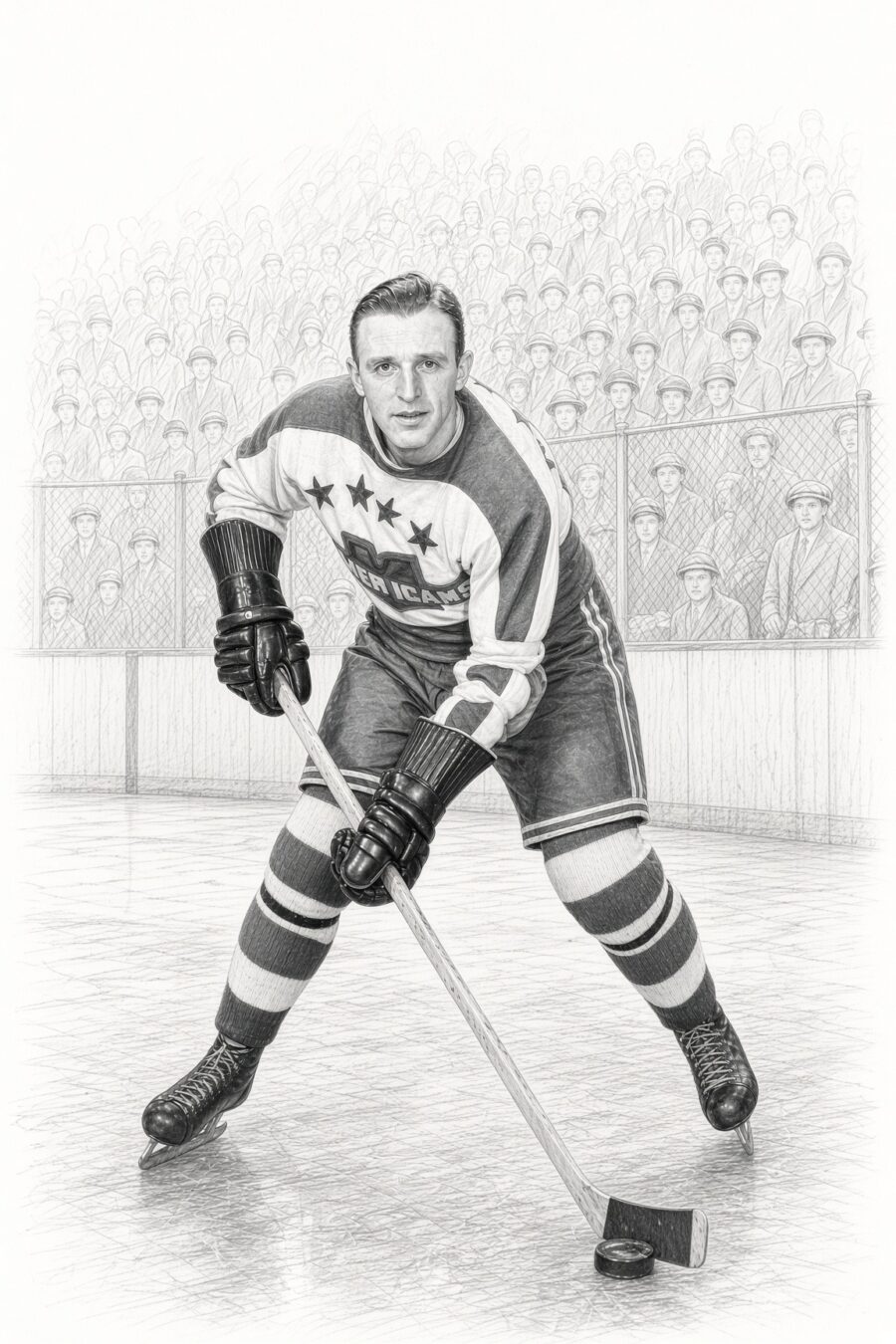
To try and gin up interest the New York Americans changed their name to the Brooklyn Americans despite, as they always had, playing out of Madison Square Garden in Manhattan. They staged something of a rally, improving to 16-29-3, and while that was still last place it was not nearly as poor a last place. Young defenseman Pat Egan broke through with a 28-point season and a second team All-Star nod and Mel “Sudden Death” Hill, whose three overtime playoff goals for Boston in 1939 gave him one of hockey’s best nicknames, in turn gave the Americans his best season yet with 37 points.

Maybe somebody remembers Egan and Hill, but I doubt it. The story was Tommy Anderson.

Anderson, playing his first and only season as a defenseman in major league hockey, recorded 41 points in 48 games, the NHL season record for the position. He led the Americans in scoring by four points over Hill, bested his own career high by a point, finished tied for eighth in league scoring overall (with Syl Apps, again, who played fewer games, again, and Gordie Drillon), helped improve the Americans’ goals against by 11 over the season before, and won the Hart Memorial Trophy with 31.62% of the vote,17 the highest vote share since Toe Blake in 1938–39.

He was the fifth defenseman in NHL history to win a Hart, joining Herb Gardiner, Eddie Shore (four times), Babe Siebert, and Ebbie Goodfellow. He was the first Hart Trophy winner to win the award on a last-place team and, with goalie Al Rollins of the 1953–54 Black Hawks, one of only two ever; in a league the size of the NHL today it may never happen again. Anderson and Rollins are two of four Hart winners from non-playoff teams, joining Andy Bathgate and Mario Lemieux. He is, as mentioned, the only eligible skater to win the Hart Trophy and not enter the Hall of Fame. He finished the season about to turn 32, and he is the only man, and probably will always be the only man, whose last participation in the NHL was winning the league MVP award.

Should Tommy Anderson be in the Hall of Fame? Of course not. In a long pro career Anderson was typically a supporting player on lousy teams and very occasionally a minor standout. If one year of brilliance got you into the Hall of Fame the place would be even more crowded than it is. The more interesting question is: how brilliant was his season really?

Hockey Reference point shares are deceptive at the best of times and get worse the further back you go. For what it’s worth, which ain’t much, the top two defensemen in point shares were Boston’s Frank Hollett with 7.8 and, way behind, Anderson with 6.0.18 Hollett played for the best defensive team in the league, anchored by Frank “Mr. Zero” Brimsek in goal; Anderson played for the worst, with goaltending by Robertson after he stopped being much good and 21-year-old Hall of Famer Chuck Rayner before he started. Hollett had 33 points to Anderson’s 41, but Hollett scored 19 goals to Anderson’s 12.

Hollett is known to the encyclopedias as “Flash” and that is almost all you need to know: he was the NHL’s all-time leading scorer among defensemen when he retired but was not particularly rated by his contemporaries. In thirteen NHL seasons, Hollett was a first- and second-team All-Star once each, both during the war. In 1942–43 Hollett broke Anderson’s year-old defenseman record; he was second-team All-Star and not a Hart finalist. Was Hollett underrated because Brimsek could stop anything less than the Wehrmacht, the Kraut Line was known for defensive excellence, and back then defensemen were expected to defend, or was Hollett really that much of a liability in his own zone? No way to know now.

The other Hart candidates, who essentially tied for second, were Apps (who won the Lady Byng), Lynn Patrick (second in the league with 55 points), Chicago centre Bill Thoms (tied for seventh in scoring with Toe Blake; also third in the Lady Byng), and Frank Brimsek, who led the league in goals against average by .4119 despite having three fewer shutouts than runner-up Turk Broda. Scoring leader Bryan Hextall was nowhere.

Probably Brimsek was the most valuable player in the league in 1941–42. But at this time there seems to have been a bias against goalies winning the Hart; the only one to do so had been Roy Worters, also of the New York Americans, in 1928–29 when in a season dominated by goaltending he improved the Americans from last place to second. That was the year George Hainsworth had a goals-against average below 1.00, the all-time season of the goalie; it would almost have been unnatural for a skater to win it. Although it looks terrific in context, Brimsek’s 2.35 GAA in 1941–42 was actually his career worst to that point. By what statistics we have, and what recollections are available, Anderson was probably legitimately the best non-goalie in the league that year.

The Hart was legitimate, but still a fluke, in the sense that it was well above Anderson’s true ability. The war years produced a lot of fluke seasons, and it’s tempting to mark Anderson down more than he deserves. There were war seasons and there were war seasons. When Maurice Richard scored his 50 goals in 50 games in 1944–45, the second-tier players on the leaderboards were a mess of young guys, old guys, mediocrities, and Habs. Apart from Anderson’s heroics, 1941–42 was a recognizable NHL season. Players had left for the war, but not too many stars. Although Canada had been at war since 1939 the attack on Pearl Harbor naturally changed the mood, and it was only late in 1941–42 or immediately after that many stars joined the military: to name but a few, the entire Bruins’ Kraut Line and Anderson himself, with more following in later seasons. The 1942–43 Bruins, without four of their six best players and with three teenagers playing regularly, plus an old Busher Jackson and an ancient Dit Clapper, hardly missed a beat and made the Stanley Cup final, which was both an all-time great coaching job by Art Ross and a sign of how far the league’s standard fell over one summer.

Anderson was one of those who took off for the forces in the summer of 1942. The Brooklyn Americans were finished, suspended at the end of the season to reduce the seven-team NHL to the Original Six. Anderson was close to Red Dutton, who lied about his age to join the First World War and suffered a serious wound at Vimy Ridge, and Anderson’s great-niece suggested that motivated Anderson to sign up.20 Though he had apparently been planning the move for some time, the news became official just before the start of the 1942–43 season, as Anderson enlisted at Currie Barracks with No. A-16 Canadian Infantry Training Centre. “Jay-A,” sports writer for the Drumheller Mail, mused that “‘Cowboy’ will be campaigning in old-time haunts should Currie Barracks ice a senior puck squad. (Betcha they do!)”21

“Jay-A” was well-informed. In the Army, Anderson got to experience something he never knew in the NHL: an excellent team. Serving as player-coach for Calgary Currie Army in the Alberta Services Senior Hockey League, Anderson led his company to a 19-4-1 record with an obscene +92 goal difference in 1942–43. The reigning NHL MVP was a second-team All-Star in Alberta military hockey,22 and in the Allan Cup playoffs lost to the Victoria Army team23 on a goal and two assists in the deciding game from former Alberta senior player Mel Lunde.24 For 1943–44 two of the Bentley brothers, Reg and Max, joined Currie for what must surely be the all-time Drumheller All-Star Team. Anderson, now commissioned a lieutenant,25 was still coaching, but his play made less of an impact on a garrison team that could have put its first line straight into the NHL. Maybe their depth was more typical army fare, for the Central Alberta Garrison Hockey League was tight all year, but Currie won in style by blowing out Red Deer, another team with NHL talent, in the deciding playoff game.26 By this time the Alberta military teams had been ruled ineligible for the Allan Cup27 and the championship was suspended altogether the next season.

It was, by wartime standards, a cushy job. Anderson saw out the war as sports officer of Currie Barracks, where he later regaled a journalist with his memories of seeing an outrageously hung-over Max Bentley hit three home runs in a services baseball game against Edmonton.28 Anderson and the Bentleys were there to train soldiers and boost morale, not to fight, and almost no players of their calibre ever saw combat. The RCAF sent the Kraut Line to Europe, where Milt Schmidt was the sports officer at RAF Middleton St. George,29 Woody Dumart was assigned to a station sports officer,30 and Bobby Bauer was a wireless mechanic;31 all three played a great deal of hockey, and apart from the common risk of air raids none heard a shot fired in anger.

Not all were sheltered. Mel Lunde, who did so much to eliminate Anderson from the Allan Cup, was killed in Normandy.32 Dudley “Red” Garrett, immortalized to this day in the American Hockey League’s Rookie of the Year award, played 23 NHL games before joining the Royal Canadian Navy, where he was killed with all hands aboard HMCS Shawinigan.33 Bob Carse, who had played 143 NHL games with Chicago and was a teammate of Anderson’s at Currie, was taken prisoner in Europe34 and survived to play 22 more NHL games. “By the end of the war, not one front-line NHL player had been killed in defence of his country and only a handful of established NHLers saw frontline combat.”35 This says nothing about the motives of the players; NHL players were tacitly, though not officially, exempt from conscription.36 They could have kept cashing their NHL cheques and did not, and unlike in the First World War when the 228th Battalion joined the National Hockey Association with a combination of legitimate soldiers and mistreated ringers,37 military authorities treated hockey with discipline while protecting its stars.

After the war, Anderson’s NHL rights were held by the Toronto Maple Leafs, but he never returned to the big leagues. He played the 1945–46 season with the Providence Reds, apparently competently, but the rebuilding Leafs had a young defense and a 35-year-old Anderson was not what they wanted. The next season Anderson went to Hollywood in the Pacific Coast league, where his most lasting contribution was mentoring another choppy-skating defenseman named Bill Barilko, then 19 and as green as spring hay, “but,” Anderson said, “he was willing and he learned fast.”38 Kevin Shea credited Anderson with taking Barilko under his wing,39 and by the end of the season Barilko was with the Maple Leafs, there to spend the rest of his short life.

Anderson went on to coaching. Three decent years with the OHA’s Oshawa Generals led to the Pittsburgh Hornets, AHL affiliate of the Maple Leafs, for 1950–51. With a couple of good young players in George Armstrong and Tim Horton, the Hornets went a modest 31-33-7. The AHL was a weird league, so their first-round playoff opponent was the positively bad Springfield Indians. Pittsburgh swept the series, which was fair enough, but then swept the 38-28-4 Hershey Bears in the semi-final, which was not. In the final against the season’s dominant team, the Cleveland Barons, little-fancied Pittsburgh got the series to seven games before falling. Under normal circumstances Anderson’s job would have been safe, but that offseason the Canadiens fired King Clancy as coach of their AHL affiliate. It was physically impossible for Conn Smythe to not offer Clancy a job, and no power on earth could have saved Anderson then. Anderson was let go, with the Hornets indicating an undefined future job for him in the Maple Leafs organization that never seemed to materialize.40 In justice to Smythe and Clancy, Clancy led the Hornets to the AHL title the next year and another finals appearance the year after.

Luckily for Anderson the Calgary Stampeders, meaning the senior hockey team rather than the football team, were turning pro in the Pacific Coast league for 1951–52. Anderson’s old pal Red Dutton, now a Calgary businessman, was involved with the Calgary Exhibition and Stampede41 and an old coach of Dutton’s, Lloyd Turner, was general manager of the hockey club. Turner wanted a “name” coach for the Stamps’ entry into professional hockey,42 and who could be a more natural fit than Cowboy Anderson?

The Stampeders found pro hockey tough, and after a 3-8-1 start43 Anderson resigned in November. “This club, I believe,” said Anderson in his parting remarks, “will produce better hockey under different coaching, for so far the players haven’t shown the hockey of which they are capable.”44 New coach Hank Blade went 21-29-8 for the rest of the season.45

From there, Anderson’s hockey career quietly wound down. Like most players who didn’t win Hart Trophies, Anderson went from glory at Madison Square Garden to ordinary, blue-collar work near his hometown. He coached the senior Drumheller Miners in 1955–56,46 finishing 5-20-3 and last. Unless it was a different Tommy Anderson, he curled and won bonspiels.47 He refereed at least occasionally in local youth games48 and dusted off the stick for charity games here and there.49 The Drumheller Mail reported, a half-century later, that Anderson ended his days working in the family plumbing business in Sylvan Lake,50 where he died on September 20, 1971, age 61, leaving neither wife nor children.51

A hundred NHL players had some version of Tommy Anderson’s story: bad teams, hard breaks, military service, and an ordinary life after hockey. Only Anderson had a Hart Trophy in the middle of it. Tommy Anderson, who went from prairie cult favourite to the most improbable of NHL MVPs and back again, deserves more than a quiz question.

  1. Pat Kolafa, “Campaign for Tommy Anderson to enter Hockey Hall of Fame,” The Drumheller Mail (Drumheller, AB), January 22, 2025, https://www.drumhellermail.com/sports/36664-campaign-for-tommy-anderson-to-enter-hockey-hall-of-fame.
  2. “Andersons show a good brand of hockey on Thurs.” Drumheller Mail (Drumheller, AB), March 14, 1929, 9.
  3. “Who’s who in the Miners – the forward line,” Drumheller Mail (Drumheller, AB), December 12, 1929, 5.
  4. “A few statistics,” Drumheller Mail (Drumheller, AB), February 27, 1930, 2.
  5. “Miners bid ‘au revoir’ to Allen [sic] Cup for year 1930,” Drumheller Mail (Drumheller, AB), February 27, 1930, 2. “Allen Cup” is a typo, but I regret to inform you “Calgary Bronks” is not.
  6. “Connie King is listed by fans as best player,” Drumheller Mail (Drumheller, AB), February 27, 1930, 2.
  7. “Miners to lose Anderson-King next season,” Drumheller Mail (Drumheller, AB), June 5, 1930, 1.
  8. Unless otherwise noted all minor-league statistics are from HockeyDB.
  9. “Rambling around local sport circles,” Drumheller Mail (Drumheller, AB), May 24, 1934, 2.
  10. Unless otherwise noted all NHL statistics are from Hockey Reference.
  11. From the stat line it is just possible Anderson played at least some defense in 1940–41 but not, I think, likely. Anderson was always a playmaker and had put up 4 goals and 21 assists as a left winger in 1937–38. As late as October 1941 one newspaper report listed him as a forward in Americans training camp: The Canadian Press, “Dutton arranging deal for veterans,” Lethbridge Herald (Lethbridge, AB), October 8, 1941, 5, https://digitallibrary.uleth.ca/digital/api/collection/herald/id/174517/download.
  12. Alan Randal, “Sport Simmerings,” Prince Albert Daily Herald (Prince Albert, SK), January 11, 1939, 6, https://princealbertlibrary.ca/padh/1939/January/Jan%2011,%201939.pdf.
  13. “Tommy Anderson-Connie King make hit with Moguls,” Drumheller Mail (Drumheller, AB), November 13, 1930, 1.
  14. Stan Fischler, “Tommy Anderson won Hart Trophy in only season as NHL defenseman,” NHL.com, September 7, 2021, https://www.nhl.com/news/tommy-anderson-won-hart-trophy-in-only-season-as-nhl-defenseman-326084034
  15. Joe Pelletier, “Tommy ‘Cowboy’ Anderson,” Greatest Hockey Legends, January 11, 2016, http://www.greatesthockeylegends.com/2009/12/tommy-cowboy-anderson.html.
  16. Fischler, “Tommy Anderson.” Hockey Reference says Anderson began playing defense in 1939, but going off the quotes in Fischler, other newspaper accounts, and the shape of Anderson’s statistics, Fischler is right and Hockey Reference is wrong. On the other hand, Dutton was not Americans head coach in 1941, Art Chapman was. But on the other other hand, it was obviously Dutton’s team no matter who had what job title.
  17. “1941-42 NHL Awards Voting,” Hockey Reference, https://www.hockey-reference.com/awards/voting-1942.html#all-hart-stats.
  18. Hockey Reference says Woody Dumart (6.2) was a defenseman that year but I think Hockey Reference is on glue; he was a career winger and Dumart’s place on the Kraut Line during the Second World War gives his position unusually strong testimony.
  19. Save percentage had not been invented yet.
  20. Kolafa, “Campaign for Tommy Anderson.”
  21. “Jay-A,” “Rambling around local sport circles,” Drumheller Mail (Drumheller, AB), September 3, 1942, 2.
  22. Don MacEachern, “Where the Stars Were: Service Hockey in Western Canada in 1942–43,” Society of International Hockey Research Journal (2004), 41, https://mbhockeyhalloffame.ca/wp-content/uploads/history/WWII_ServiceLeagues.pdf.
  23. MacEachern, 43.
  24. The Canadian Press, “Victoria Downs Currie to Win West Semi-Final,” Prince Albert Daily Herald (Prince Albert, SK), April 1, 1943, 6, https://princealbertlibrary.ca/padh/1943/April/April%201%2C1943.pdf.
  25. MacEachern, 41.
  26. “Currie Soldiers Win Puck Title.” Edmonton Journal, March 13, 1944, 7, https://news.google.com/newspapers?id=xx5lAAAAIBAJ&sjid=_ocNAAAAIBAJ&pg=1189,1154078.
  27. The Canadian Press, “Winning Navy Teams Ineligible for Cup Play.” Prince Albert Daily Herald (Prince Albert, SK), March 1, 1944, 6, https://princealbertlibrary.ca/padh/1944/March/Mar%201%2C1944.pdf. Despite the title, the article body establishes that the Army teams were ineligible as well.
  28. Bob Sheridan, “Look Who’s Talking,” Drumheller Mail (Drumheller, AB), November 30, 1955, 6.
  29. Maj. Mat Joost and Joanna Calder, “Boston Bruins Legend and Former Member of the RCAF Passes Away,” Gateway Gazette, February 8, 2017, https://gatewaygazette.ca/boston-bruins-legend-former-member-rcaf-passes-away/
  30. Harold John Andrews, “Memoir,” Harold John Andrews Collection, Canadian Letters and Images Project, Vancouver Island University, accessed October 12, 2026, https://www.canadianletters.ca/document-13919.html.
  31. The Associated Press. “Schmidt Rates Salute from Rest of Kraut Line.” Prince Albert Daily Herald (Prince Albert, SK), November 6, 1943, 6, https://princealbertlibrary.ca/padh/1943/November/Nov%206%2C1943.pdf
  32. Veterans Affairs Canada, “Rifleman Melvin Emmanuel Lunde,” Canadian Virtual War Memorial, last modified May 13, 2026, https://veterans.gc.ca/en/remembrance/memorials/canadian-virtual-war-memorial/646516.
  33. The Canadian Press, “Official Casualty List of HMCS Shawinigan,” Edmonton Bulletin, December 7, 1944, 3, https://www.newspapers.com/article/the-edmonton-bulletin-official-casualty/159692202/.
  34. The Canadian Press, “Hockey Star is Prisoner of War,” The St. John’s Daily News, November 22, 1944, https://dai.mun.ca/pdfs/dailynews/DailyNews19441122.pdf
  35. Gabriel Stephen Panunto, “For Club or Country? Hockey in Wartime Canada, 1939–1945” (master’s thesis, Carleton University, 2000), 2, https://www.collectionscanada.gc.ca/obj/s4/f2/dsk2/ftp01/MQ57679.pdf.
  36. Panunto, 79–80.
  37. Jamie Bradburn, “In WWI, these Canadian soldiers brought a special weapon to the war effort: hockey,” TVO Today, November 11, 2021. https://www.tvo.org/article/in-wwi-these-canadian-soldiers-brought-a-special-weapon-to-the-war-effort-hockey.
  38. Fischler, “Tommy Anderson.”
  39. Jim Amodeo, “Barilko, Lewicki & Thomson,” Hockey Then & Now, December 11, 2014, https://hockeythenandnow.blogspot.com/2014/12/barilko-lewicki-thomson.html
  40. The Associated Press. “Pittsburgh Hornets Acquire Frank Clancy as New Coach,” Prince Albert Daily Herald (Prince Albert, SK), June 27, 1951, 12, https://princealbertlibrary.ca/padh/1951/June/June%2027%2C1951.pdf
  41. “Calgary Ex Elects Red Dutton President,” Billboard, November 23, 1959, 58, https://www.worldradiohistory.com/Archive-All-Music/Billboard/50s/1959/Billboard%201959-11-23.pdf. The article says that Dutton was involved with the Stampede for 12 years in 1959, i.e. back to 1947.
  42. “Tommy Anderson to Pilot Stampeders in New Prairie-Coast Puck Circuit,” Calgary Herald (Calgary, AB), August 28, 1951, 18, https://news.google.com/newspapers?nid=Hx6RvaqUy9IC&dat=19510828&printsec=frontpage&hl=en.
  43. Bob Mamini, “Under new coaching,” Calgary Herald, November 8, 1951, 23, https://news.google.com/newspapers?nid=Hx6RvaqUy9IC&dat=19511108&printsec=frontpage&hl=en.
  44. The Canadian Press, “Pacific Trimmings Steal the Limelight,” Prince Albert Daily Herald (Prince Albert, SK), November 10, 1951, 11, https://princealbertlibrary.ca/padh/1951/November/Nov%2010%2C1951.pdf. The reason for all this Prince Albert Daily Herald content is that they are thoroughly archived and searchable online and seemed to carry about any wire story with Anderson’s name on it, for some reason I don’t know but am grateful for.
  45. “Calgary Stampeders,” Elite Prospects, https://www.eliteprospects.com/team/4643/calgary-stampeders.
  46. “New Miner coach,” Drumheller Mail (Drumheller, AB), November 9, 1955, 6.
  47. “Drumheller ‘Hello Bills’ win Elks’ bonspiel,” Drumheller Mail (Drumheller, AB), January 11, 1956, 1.
  48. “Banff wins 4-2 in feature puck tilt at Kin Ice-Fest,” Drumheller Mail (Drumheller, AB), March 26, 1958, 6.
  49. The last reported of which was in April 1956: “All-Stars shade Miners 6-5 in benefit game,” Drumheller Mail (Drumheller, AB), April 4, 1956, 6. 45-year-old Anderson played for the Miners and recorded a penalty in a 6-5 loss.
  50. Kolafa, “Campaign for Tommy Anderson.”
  51. “Obituary – Anderson.” Drumheller Mail (Drumheller, AB), September 29, 1971, 5. Most secondary sources say Anderson died September 15; obituaries are not perfect but I am going with the contemporary report.

Leave a Reply

Your email address will not be published. Required fields are marked *