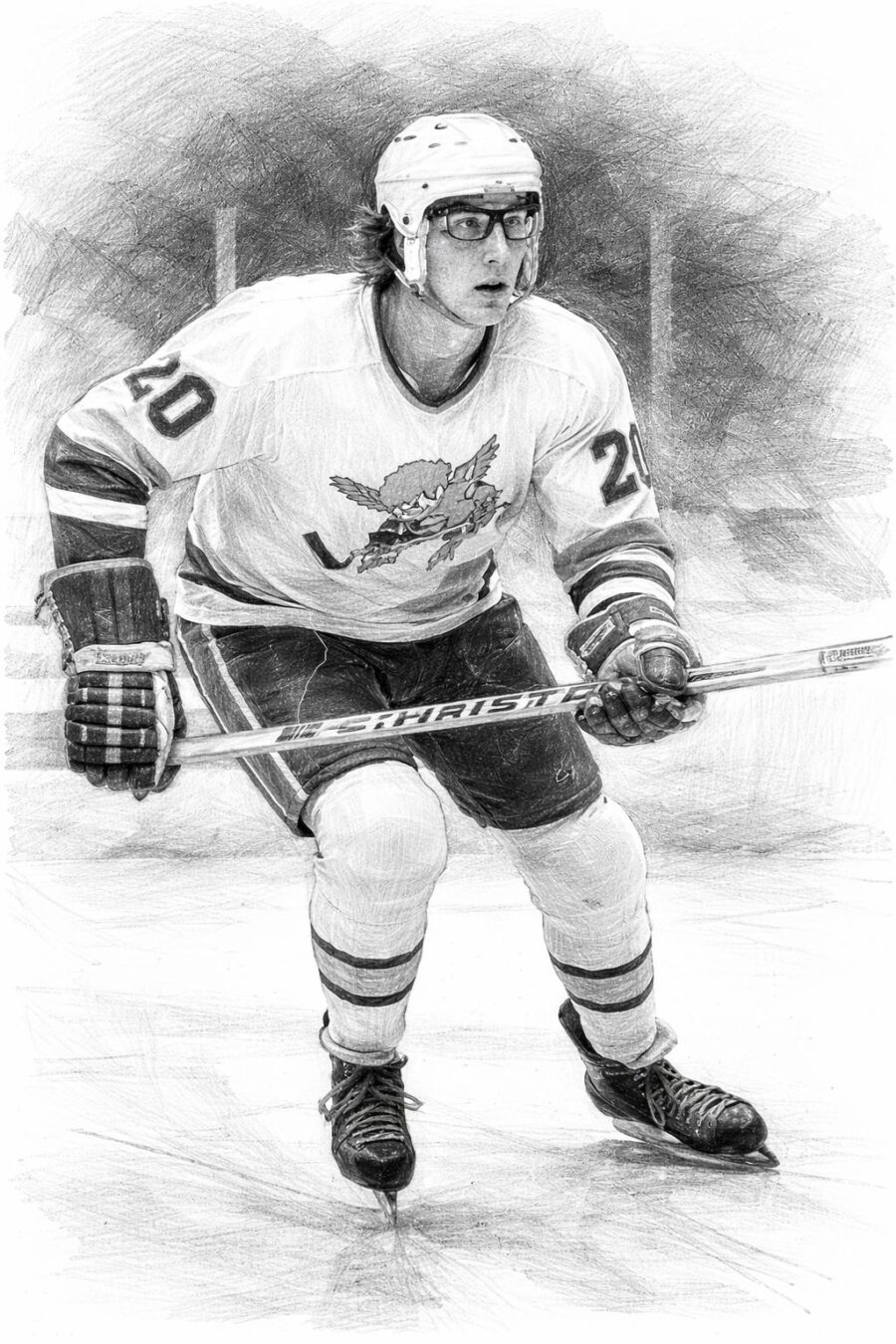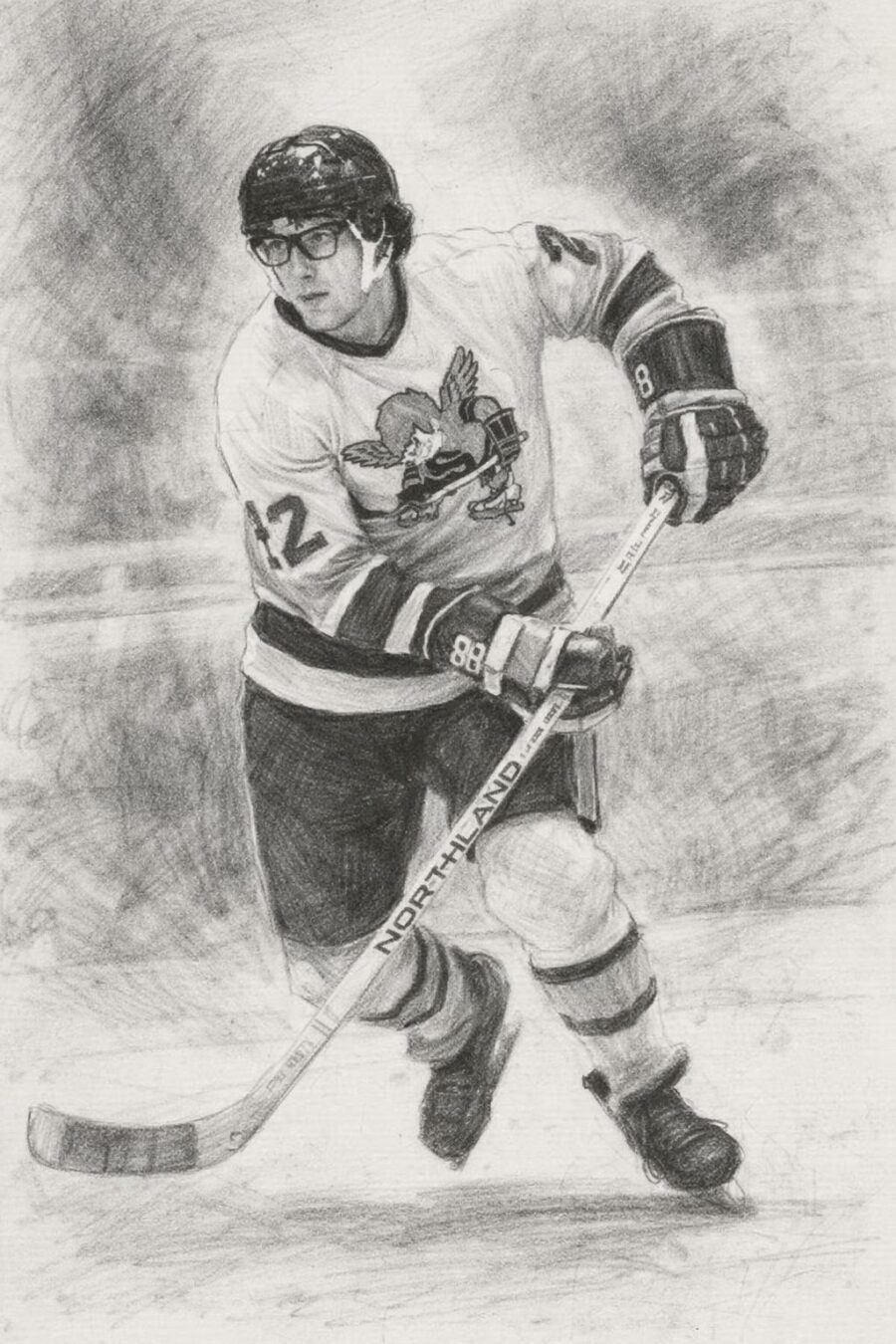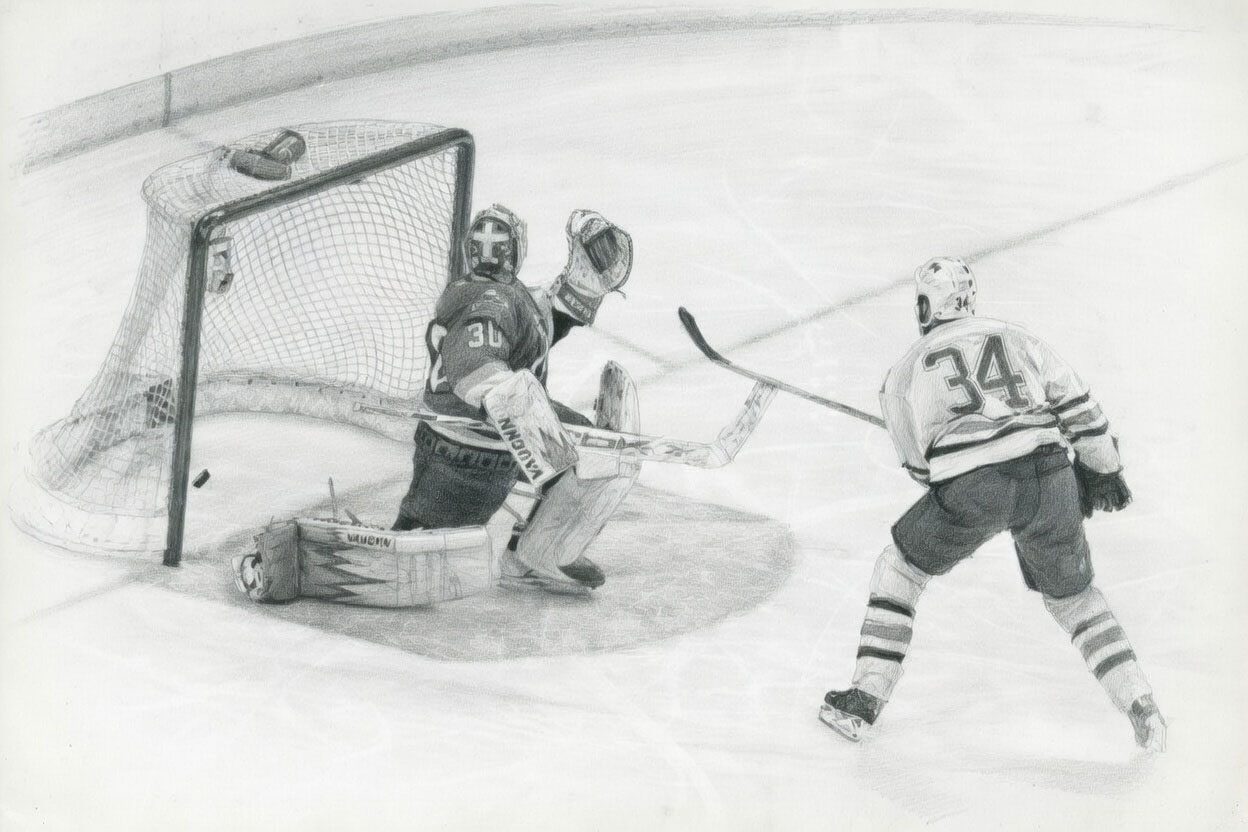
My favourite minor scene in Slap Shot comes right before that guy bellowing “you goons, you can’t skate” throws his keys. The three bespectacled ruffians score a fine team goal, the guy beans Jeff, and more movie magic happens as the Hanson brothers climb into the stands to beat the tar out of every opposing fan who crosses their fists, including coincidentally the right one.
I like it because Slap Shot is fictional[citation needed] but the cast was as legitimate as some of the stories. Michael Ontkean looks credible as the skilled Ned Braden because he was a quality NCAA scorer who could have played senior hockey if he’d wanted to (glad though we Twin Peaks fans are that he didn’t). The camera sensibly doesn’t show the other real actors trying anything more ambitious than skating in circles or dumping the puck in, but between Ontkean, the Hansons, and the famous parade of goons in the final game we see guys who could have been, and often were, paid to play hockey in real life, firing gloves off and having stick fights. A movie of minor-leaguers who could play pretty well playing pretty well is not interesting; a movie of minor-leaguers who could play pretty well hammering a drunk guy into the boards until he wets himself definitely is, but just once in a while the movie calls attention to the fact that these players are not actually jokes. The Hansons’ goal is the best-looking hockey play in the movie, which is what you’d expect because they were the best hockey players.
The Hanson Brothers, registered trademark, are Steve Carlson, Jeff Carlson, and Dave Hanson, who replaced Jack Carlson in the movie because Jack missed filming to play major league hockey. Slap Shot gave them a stylized but reasonable portrayal. Slap Shot is the all-American hockey movie, with its dying mill town, its fashion shows, and its empty old rinks, and all four “Hanson brothers” are American. Jack Carlson and Dave Hanson were definitely goons, but Steve Carlson was a skill player, and Jeff was a well-rounded minor pro. The fictional Hanson Brothers were never more at home than punching people in half-empty arenas; the real foursome, like in that one scene, showed spots of ability. All got at least a cup of coffee in the big leagues and three of the four had a sort of career. Heck with it, it’s April 1, let’s capture the spirit of the thing. How good were the Hanson Brothers?
It’s not easy to disentangle legend from history when talking about the World Hockey Association, or Slap Shot for that matter, but the most credible version of the Hanson story is this: the first incarnation of the WHA’s Minnesota Fighting Saints1 was largely a salon of courteous old Golden Gophers, twenty Ned Bradens coached by Harry Neale rather than Reg Dunlop. They finished a game above .500 in the WHA’s 1972–73 inaugural season, went out in the playoffs with a whimper, and nobody much cared. Ted Hampson, an old elegant defenseman for six NHL teams, won the most gentlemanly player award. But the GM, Glen Sonmor, was an old goon and when the Pacifist Saints didn’t catch on in the Twin Cities nobody had to twist his arm to make him add muscle.
Starting in 1973–74 the Fighting Saints emphasized the first word more than the second. Established tough guys like Gord Gallant and John Arbour turned up, while new scoring star Mike “Shakey” Walton was very happy to fight himself. The most famous fighters of all arrived by fluke. As a public relations stunt, the Fighting Saints held open tryouts before the season. Such tryouts happen today, you pay some nominal fee, they give you a jersey, you scrimmage with some plumbers while the coaches scroll Tik-Tok, and then you go home. Like these, Minnesota’s camp was a PR stunt, but as happens just often enough to make the stunt work, a player somehow caught the team’s eye. In this case three players wearing huge, black-rimmed safety glasses (yes, those are authentic, until as established pros the Carlsons could afford contacts). Jack Carlson had a small reputation in Minnesota junior hockey, Steve and Jeff were totally unknown, but the unit punched its way through the open tryout hard enough that they got an invite to an expanded camp for legitimate pro prospects. They punched their way through that too, then punched their way through the main team training camp, and while they were sent to senior hockey for some seasoning, the Fighting Saints knew they had something2.
In 1974–75 Jack Carlson, aged 21, got his first call-up to the now very aptly-named Fighting Saints. The WHA’s “Killer” Carlson was not a 5’10” nebbish-looking actor like Slap Shot‘s Jerry Houser, but a 6’3″, 200-pound slab of muscle whose real nickname, “The Big Bopper,” might have been even better than fiction. Besides him Minnesota had Arbour, Gallant3, Ron Busniuk, Bill Butters, and Curt Brackenbury putting on the foil (in Brackenbury’s case, literally until the WHA brought in a rule against it). Bill Goldthorpe, the real Ogie Ogilthorpe, joined for the playoffs and picked up 25 PIMs in three games. Butters, Brackenbury, and Carlson made up the “BBC Line,” sent out for the playoffs to jump the gentlemanly Larry Pleau’s New England Whalers scoring line; the goons won the brawl but lost the game and the series. The BBC Line stayed together to the tune of 613 combined penalty minutes in 176 games in 1975–76, then the Fighting Saints missed one payroll too many and folded. It was the ’70s.
A funny thing happened on the way to infamy. Brackenbury was a cementhead, with some offensive touch for his role but an overall minus. Butters could work his own zone a bit but really wasn’t a lot better, but Jack Carlson could kinda play. He picked up 36 WHA goals and 87 points in 272 games, and did it respectably: averaging 1.28 shots per game and a 10.4% shooting percentage despite seeing zero power play time and usually going out with the grinders. His best major league year was with the 1977–78 New England Whalers. It was a good fit for Carlson, the Whalers were as tough as anybody but not a team of goons, and Jack chipped in nine goals and 29 points with a +9 in 67 games of fourth-line duty. In the playoffs he was a scratch nearly as often as not but managed a couple points and a +4 that was one off the team lead. He was still one of the younger regulars on the team, the same age as Marty Howe, but when he wasn’t called on to fight Carlson was already a useful depth player. After that his back started to flare up badly, leading to spinal fusion surgery that took him out for the 1979–80 season, and he was never quite the same afterwards but had proven some quality.