Skip to content

How Good Was Tony Hand?

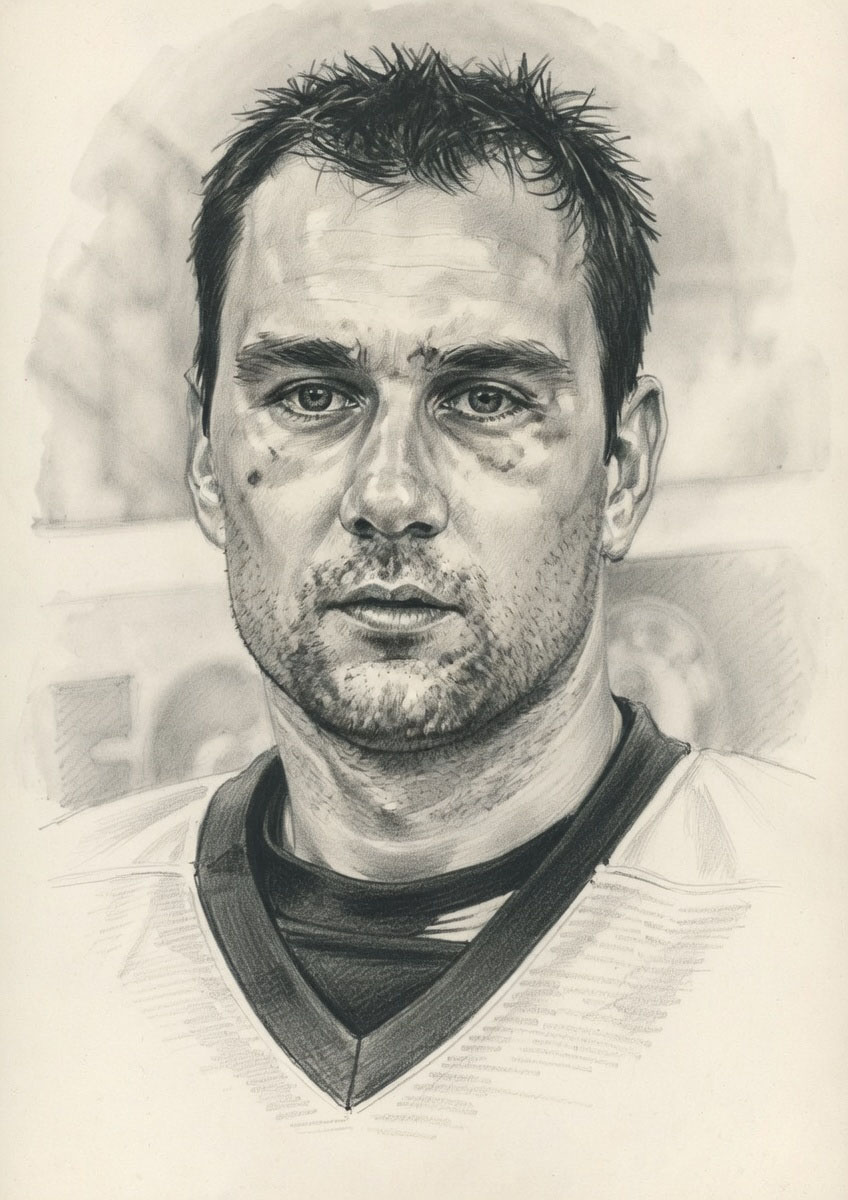
Anthony Hand MBE (August 15, 1967 –) is the greatest British born-and-bred ice hockey player of all time. This is not a vividly hot take; one might as controversially say that Patrick O’Brian liked ships. In British-trained hockey Hand is first and the rest nowhere. Liam Kirk, the best British-trained player of the twenty-first century to date, may make it an argument before the end, but Hand has all the qualities of a legendary player for a bottom-rate team: a lack of international success, a great deal of personal recognition for his talent, and an enormously long career. Hand was active in top-division British hockey, with interruptions, from 1983 to 2009, played in the second division until 2015, and although statistics are unreliable is probably the all-time leading scorer of the old British League.

Born, raised, and whenever he could get away with it professionally based in Edinburgh, Hand is best remembered for having been drafted 252nd and last overall in 1986 by the Edmonton Oilers; the first British-trained player ever selected in an NHL Entry Draft, supposedly on the suggestion of former Oiler Garry Unger, who played a few years in England to close out his stat book. Attending a couple training camps with one of the best offensive teams in hockey history, Hand did well enough to seriously interest Glen Sather in giving him a minor-league deal, but Hand was homesick and, apart from a short but successful spell with the WHL’s Victoria Cougars and a second strong training camp, played his entire professional career in England and Scotland. Whenever one hears the story of Tony Hand, one will hear Glen Sather’s quote that Hand “was the smartest player [in Oilers camp] other than Wayne Gretzky.” Small wonder he is known as “the Scottish Gretzky.”

But really, how good was he? Hand played three league games outside of Great Britain, and those were as a junior. His British career was immense and successful but coincided with the all-time nadir of British international hockey, where the Brits were at times as low as the fourth division of the World Championships with the likes of New Zealand and Spain. Hand led a modest resurgence, culminating to a glorious top-pool appearance at the 1994 World Championships, but Hand failed to score, the Brits lost all five of their games, and never managed to escape the second division during the rest of Hand’s career, though they were sometimes quite good there.

Hand has enjoyed a modest prominence in the past few years. When I wrote about Hand fifteen years ago1, I spent a lot of time scrapping around weird British hockey forums to find information. The next spring TSN ran a short segment on Hand as part of their NHL Entry Draft coverage, and his interesting story came up to the next generation, who resurrect his career here and there through TikToks and YouTube features. The Hockey News had a short article on him on the occasion of his playing retirement and he is the subject of a 2024 documentary, The Other Side of Edinburgh, that has a limited online release. He was inducted into the British Ice Hockey Hall of Fame in 2016 and, as a holder of the Torriani Award, the IIHF Hall of Fame in the 2017. If that sounds a little late in the day it’s because Hand only stopped bloody playing after the 2014–15 season, when he was the third-leading scorer for second-division Manchester Phoenix at age 47.

Hand’s resume as the best British-trained player, and one of the few best British players overall, is based substantially off longevity and a romantic legend, with comparisons to Gretzky and constant thoughts of the difficult road he chose not to take2. He turned down two chances to play serious hockey overseas when he was in his teens, and may not have had another. Wikipedia claims that in his late 20s he was offered a place with HPK of the Finnish league, but does not cite a source and the story seems impossible to back up these days. For Hand, we’re dealing with a lot of “might-have-beens” and a woeful sample of first-class games:

  1. Three games with the 1986–87 Victoria Cougars of the WHL. Hand played superbly, with eight points, but returned home to Scotland. Victoria wanted him back, that season or the next, but he was homesick and didn’t care for the intensity of major junior hockey3.

  1. The 1994 World Championships, the only time Great Britain played at the top level during Hand’s career. The Brits lost all six games heavily and Hand, 27 years old and fresh off his best-ever 222 point season, was pointless.

Three WHL games obviously prove nothing either way. Six games in the 1994 World prove twice nothing. Hand was very good in the WHL and disappointing in the Worlds. The 1994 World Championships were the biggest stage Hand had ever or would ever play on, the only time he felt any pressure beyond the rather limited British hockey fanbase. He did not acquit himself well, though his entire team was way out of its depth, and their best overall game was probably their 8–2 loss to Canada. That Hand disappointed on the big stage is a fact; however, it hardly defines so long a career.

To assess Hand’s quality, we have to to consider what he did in Britain. Fortunately, enough fairly-notable players crossed Hand’s path at enough points for us to attempt to piece together a picture. Center Ken Priestlay was a teammate of Hand’s first in Victoria and then in Sheffield. In-between he had a fairly good go of a North American pro career, including 61 points in 168 NHL games with Buffalo and Pittsburgh and a tour with Father Bauer’s Canadian national team. Priestlay was a player we can all picture, a little skilled guy who really wasn’t quite skilled enough to stick in the show but deserved his shot and probably had lots of fans saying he was underrated. He and Hand were born nine days apart and Priestlay was a teammate of Hand’s in Sheffield for four seasons, an unusually good sample.

Priestlay’s first year alongside Hand was the last of the old British League (usually called the BHL) a mostly-domestic circuit with the good players putting up scores better suited for pinball machines. Hand played in the BHL for a decade, mostly for his local Edinburgh team, led his team in scoring every year but his first, often by preposterous margins, won a league scoring title, and was top ten a few other times. He was not dominant in the BHL, though he was very good, and accumulated his all-time record with consistency and longevity in a league that seldom paid enough to live on, seldom attracted foreign players of any quality for more than a season or two, and frankly was somewhat silly.

Starting in 1996–97 the BHL was reorganized into two leagues, with the British Ice Hockey Superleague (BISL) on top. With a reported salary cap of £400,000, the BISL teams attempted and to some extent succeeded in paying imports to raise the level of the game: the Sega Genesis point totals collapsed almost immediately, but unfortunately such salaries meant that the league collapsed after seven seasons as well. A major addition in the BISL era was Ed Courtenay, who was also about Hand and Priestlay’s age: he scored seven goals in 44 NHL games with San Jose in the early ’90s and, immediately after tying for the ECHL scoring title, moved to Sheffield and played two full seasons alongside Hand and Priestlay to begin a long and highly successful British career. It’s worth seeing them side-by-side.

Hand Priestlay Courtenay
Season Team GP G A Pts GP G A Pts GP G A Pts
1986–87 Victoria (WHL) 3 4 4 8 33 43 39 82
1995–96 Sheffield (BHL) 35 46 77 123 36 58 40 98
1996–97 Sheffield (BISL) 41 13 32 45 34 25 12 37
1997–98 Sheffield (BISL) 44 14 44 58 43 19 33 52 40 27 21 48
1998–99 Sheffield (BISL) 36 11 27 38 41 19 24 43 42 26 26 52
Total Sheffield (BISL) 121 38 103 141 118 63 69 132 82 53 47 100
Per Game Sheffield (BISL) 0.21 0.85 1.17 0.53 0.58 1.12 0.65 0.57 1.22

Priestlay and Courtenay were not the only ex-NHLer in Sheffield in this period, just the longest-lasting and best forwards. Ron Shudra got in ten games with the 1987–88 Oilers then spent a long British career mostly in Sheffield, overlapping Hand’s entire tenure, but as a defenseman is hardly worth comparing statistically. Derek Laxdal, who played 67 NHL games and is better known as a coach, had 12 goals and 16 assists over 47 games in Sheffield from 1998 to 2000. Forward Jason Lafrenière played friggin’ everywhere at one time or another, including 146 NHL games with three teams and 22 games with Hand in 1996–97 (11 goals, 18 assists). A few others had cameos too short to bother with.

Hand spent the next two years back home in Scotland, in 1999–2000 going 40GP 8G 35A and finishing third in team scoring, though nearly level on points-per-game, behind two former blink-and-you-missed-’em NHLers (Shawn Byram and Yves Heroux). In 2000–01 Heroux left but Ed Courtenay re-united with Hand, and with this support Hand won the team points race by 17 points and tied for second in league scoring behind once-and-future IHL standout Greg Bullock. After this, Hand dropped down to the second division. He was certainly not washed up, but clearly preferred to play in his home town and, given that Ayr folded mid-season not long after, financial considerations may have pushed him down a level.

Hand won the BISL scoring title in 1997-98 (tied with Mark Montanari), the only non-Canadian to ever take a BISL scoring championship. He was one of only two British-trained players, with David Longstaff4, who ever finished top ten in BISL scoring: Longstaff did it once, Hand did it three times, though Hand played only five the BISL’s seven seasons. Hand finished tied for fourth in all-time BISL points with Rick Brebant and was second all-time in points-per-game among players with at least 150 BISL games at 1.15, behind Courtenay with 1.20 and essentially tied with former QMJHL star Paul Adey on 1.14. In short, Hand was very nearly the best long-term forward in the best-ever British hockey league; the league contained, and the only player superior to him was, players who had been at or near an NHL standard.

When Hand returned to the British top flight in 2004–05 the big-spending BISL had been replaced with the more sustainable Elite Ice Hockey League. Hand was getting old but the standard of play was lower so he kicked around the league scoring leaders for a few more seasons. The most interesting season was 2005–06, when 38-year-old Hand had 51 points in 43 games to rather handily lead the bad Edinburgh team he also coached. Fifth in the league, but 23 points behind (and have a caramel if you remember this one) 37-year-old Belfast Giant Theoren Fleury, the best player the EIHL has ever had who dragged his actually-rather-good-by-local-standards linemates of George Awada and our old pal Ed Courtenay to 1-2-3 in the scoring race.

Hand had spent his own 37-year-old season in Belfast, along with Awada (Courtenay had not arrived yet). While nobody seriously expects Tony Hand to be competitive with Theo Fleury, a borderline Hockey Hall-of-Famer, it’s worth spelling it out.

Hand Awada Fleury
Season Team GP G A Pts GP G A Pts GP G A Pts
2004-05 Belfast (EIHL) 50 19 49 68 50 32 23 55
2005-06 Belfast (EIHL) 43 22 30 52 34 22 52 74
Total Belfast (EIHL) 50 19 49 68 93 54 53 107 34 22 52 74
Per Game Belfast (EIHL) 0.38 0.98 1.36 0.58 0.57 1.15 0.65 1.53 2.18

In a small sample old Theoren Fleury was a much better player than old Tony Hand. Fleury had better support (Courtenay was overqualified for the EIHL), but nothing like enough to make up the difference. Being around Fleury rather than Hand helped Awada’s statistics noticeably and Hand’s specialty by this point was his playmaking. Mostly this reminds us the difference between what a player who may have been pretty good, and a really good player, achieves at these levels. It’s fun to romanticize the Scottish Gretzky, but we are not looking at an NHL star-calibre player who happened to play in the Lowlands rather than Long Island.

But was Tony Hand good enough to play in the NHL at all?

Players good enough to stick in the NHL have never spent a lot of time in the British leagues, unless like Fleury or Garry Unger they were old, hadn’t played in a while, and had a hankering to compete for some scoring titles. Ken Priestlay and Ed Courtenay were not “NHL players” in the sense of being regulars; they were guys who got a decent shot, put up enough statistics that fans of their teams probably remember them, but couldn’t hang around.

However, Hand was probably a bit better than Priestlay and about as good as Courtenay, whose prominence in this article is because he adjusted unusually well to British play. Quite a few other ECHL/borderline-AHL-shaped players went to Britain in the BISL days, more than one article could ever encompass, and several did rather well, but Hand (and Courtenay) were a cut above in performance and consistency. Scott Allison, a former NHL first-round pick and one of those great Oilers 1990s draft busts, was good over seven seasons in England, but he was four and a half years younger than Hand and still was not as good on the best day of his life.

We can never know what would have become of Hand if he took Glen Sather’s offer and spent the last years of his teens developing in North America because there are too many “ifs” and “buts.” However, as it was, playing almost entirely on the island of Britain, Tony Hand developed a talent that probably would have got him a small NHL career, had he chosen to take the chance and grind out life in the bus leagues until a few injuries got him called up. Wayne Gretzky probably wouldn’t have bounced 40 goals off him like Blair Macdonald, but he would have made it.

  1. From which this article heavily draws. See: Benjamin Massey. “Today in non-NHL hockey: September 20, 1981: Tony Hand makes his debut.” The Copper & Blue, September 20, 2012. Accessed March 17, 2026. https://web.archive.org/web/20121026080501/http://www.coppernblue.com/2012/9/20/3334552/today-in-non-nhl-hockey-september-20-1981-tony-hand-makes-his-debut. Not recommended to read for pleasure.
  2. Your average elite British hockey player moved to Canada or the United States when he was in his teens to play midget. Even with foreign-trained players, “All-Time Team GB” must be the worst “all-time national team” with two Hall-of-Famers:

    Adam Brown Tony Hand Stumpy Thomas
    Brendan Perlini Gavin Kirk Ken Hodge
    Liam Kirk Jim Conacher Peter Lee
    David Longstaff Jim McFadden Norman Mann
    Tommy Anderson Jack Evans
    Steve Smith (EDM/CGY) Joe Hall
    Dunc Munro Boots Smith
    Charlie Gardiner
    Hockey Hall of Fame NHL All-Star Game

    Backups are Byron Dafoe in goal and “don’t think about it, you don’t want to know” at all other positions. Tommy Anderson spent most of his career on left wing but converted to defense in 1941–42 and won the Hart Trophy; he is the only eligible non-goalie to have won the Hart and not be in the Hockey Hall of Fame. (Win a trivia contest any time with that one). Though among the least accomplished Hart winners ever he wasn’t a bad player, but a lot of these nobodies are either ancient bit players on bad teams or war-time NHLers who went back to the Chrysler plant as soon as peace broke out. They don’t get Nathan Walker (who plays internationally for Australia) or Owen Nolan (who’s Northern Irish), and boy could they use ’em. Tony Hand centres the first line not because this article will go on to prove he was an elite player, but because somebody has to. Gavin Kirk, the 2C, was born in London, raised in Toronto, and had a pretty useful WHA career as a second-rate scoring guy. No relation to Liam I am aware of.

  3. Craig. “Tony Hand: the Scottish Wayne Gretzky.” The Cougars Hockey Project, March 3, 2021. Accessed March 17, 2026. https://www.cougarshockeyproject.ca/post/tony-hand-the-scottish-wayne-gretzky.
  4. Father of the soccer players.

Leave a Reply

Your email address will not be published. Required fields are marked *