Skip to content

The Crushing Futility of the Philadelphia Quakers

Philadelphia, Pennsylvania got its first NHL team in the 1930–31 season. The Pittsburgh Pirates, in this context a previously-successful hockey team, moved across the Allegheny Mountains at the instigation of owner Benny Leonard, the legendary lightweight boxing champion who was a Jewish kid from New York but had fought many of his most famous bouts in the City of Brotherly Love. Granted, the Pittsburgh Pirates in their last season had been a terrible hockey team, with a record of 5-36-3, nine wins below the next-worst team in the NHL, but they had picked up 19-year-old future Hockey Hall of Famer Syd Howe, useful young forward Wally Kilrea, and heavyweight defenseman Allan “Big Pete” Shields from Ottawa in the offseason, so in Philadelphia the newly-christened Quakers were hardly going to be worse.

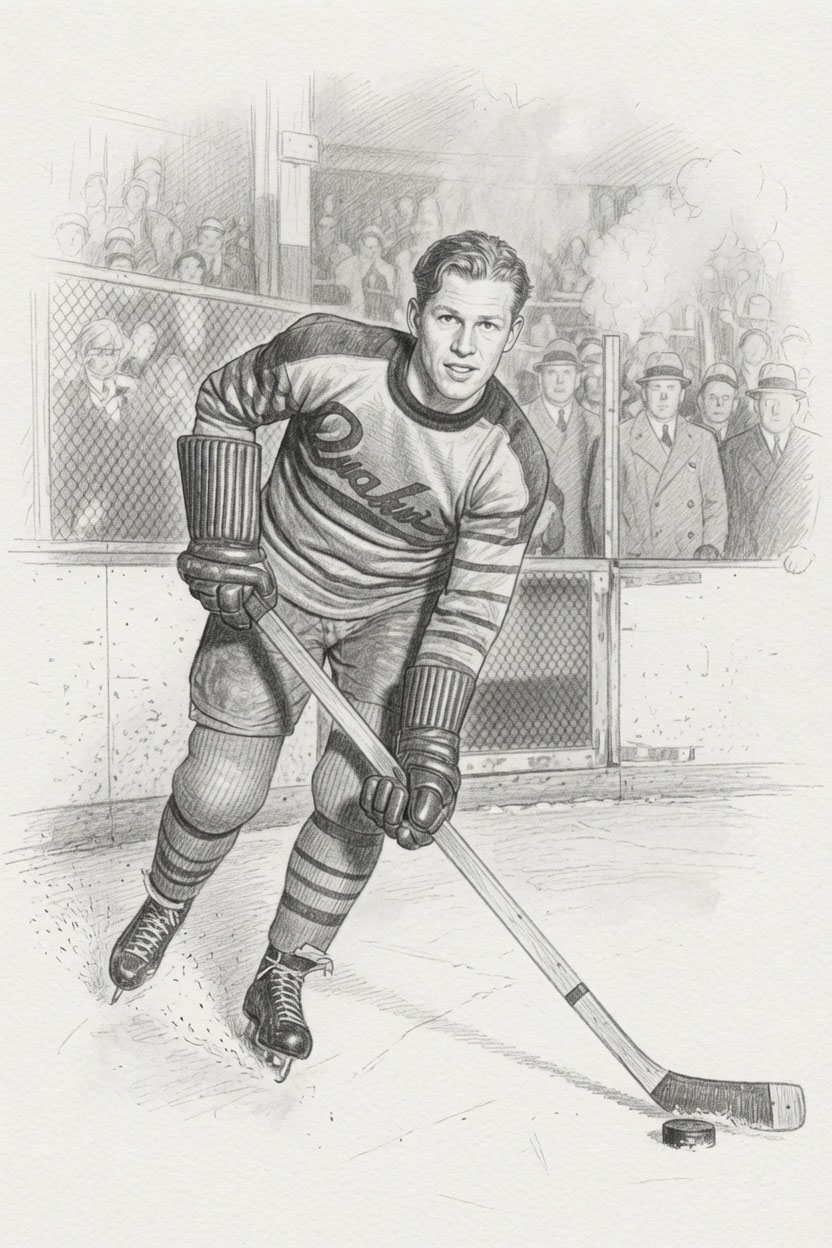
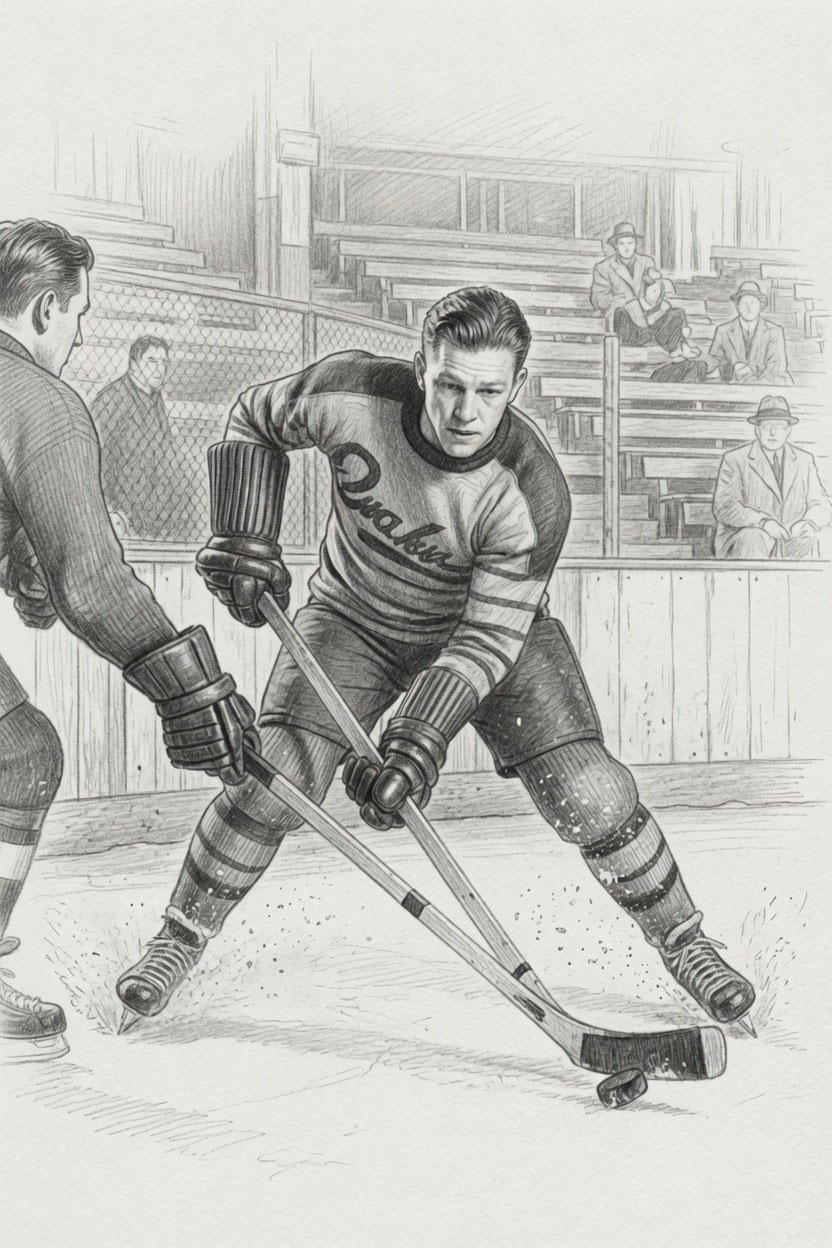
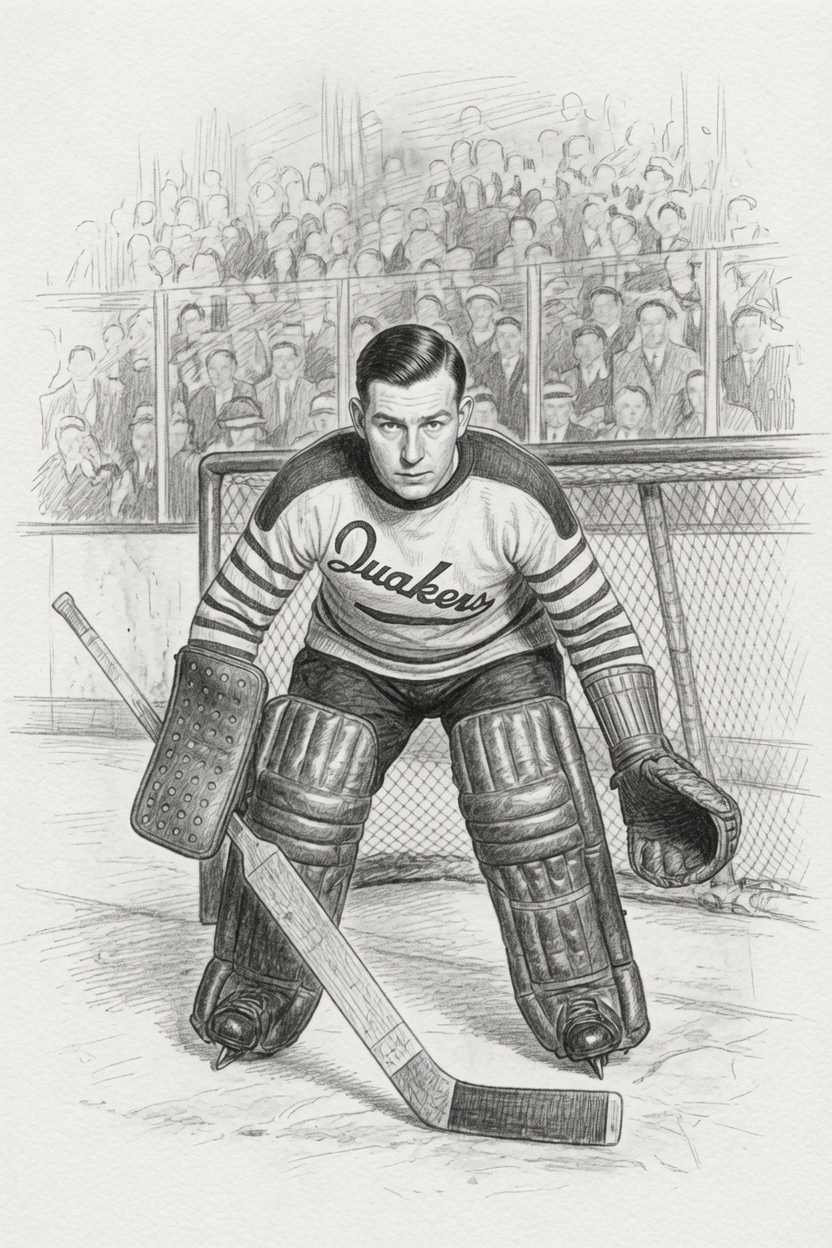
With their tiger-stripe sleeves and attractive cursive chest logo, the Quakers actually seem to have looked rather sharp. Everything was black and white in the 1930s so maybe they were ghastly in person but the surviving photos show a timeless quality that could walk into a Heritage Classic and sell 20,000 sweaters today. They had a few neat players: besides Howe, a young, tough little forward named Gerry Lowrey could chip in points, Kilrea wasn’t in Howe’s class but went on to 316 NHL games in an era where that meant something, Shields and Johnny McKinnon gave established defense, skipper Hib Milks wasn’t bad, and rookie starting goalie Wilf Cude was only 20 when the season started but became solid with the pre-war Canadiens. And Philadelphia was a hockey city: their Can-Am team, the Philadelphia Arrows, drew 4,000 or so fans a night to the Philadelphia Arena.

This is all a rather feeble look at the bright side, for the Philadelphia Quakers were in fact completely doomed. Benny Leonard was only the official owner; the real man was bootlegger “Big Bill” Dwyer, who besides his unsavory reputation was also the owner of the New York Americans and therefore could not be officially involved with the Quakers. They had no stars and their few NHL-level talents were either too old or too young. Off the ice, the Philadelphia Arena was a 5,000-seat barn unsuitable for major league hockey in a declining neighbourhood. Pittsburgh was being ravaged by the Great Depression, but Philadelphia was even worse. The harder the Quakers organization tried, the more pathetic things became, and they did not try for long. In the end they suffered the perhaps-unique distinction of being an NHL team outdrawn by a minor hockey team in the same building.

And somehow they did get worse. The 5-36-3 1929–30 Pittsburgh Pirates became the 4-36-4 Philadelphia Quakers. By points percentage it is the worst two-year run in NHL history, yes, worse than the expansion Washington Capitals. In the end the Quakers couldn’t even fold properly. Frankly it’s a miracle hockey survived in Pennsylvania at all.

They say that, on opening day, November 11, 1930, Benny Leonard had the Philadelphia Arena staff turn up in tuxedos and draped banners from the rafters. At the time this would have communicated not so much “class” as “an attempt to communicate class;” it was the sort of thing you did at a boxing match, when the mobsters and their goombas, the crooks and the judges, would be dressed to the nines because everybody knew that it was all part of the pageant, the spectacular ring girls and the faux-Monte-Carlo ushers, to watch men throw punches in a fight that, just maybe, had not been decided in advance this time. But that was okay; Philadelphia was a boxing town in those days. The Arena had seen plenty of quality boxing, including a Gene Tunney light-heavyweight fight. The Quakers were speaking the city’s language, and it worked. While 4,500 men was not a great opening-night draw, it was close to the Arena’s capacity for hockey, and if things had stayed on that level life might have been less than miserable.

Unfortunately, those 4,500 patrons, shown to their seats by the overdressed staff, sitting beneath the rented banners, got to watch the Quakers lose 3-0 to the New York Rangers. Shots on goal were not kept in those days so we can’t say exactly how bad it really was, but the Rangers were a middle-of-the-pack team and even if they’d been great there hasn’t been a 3-0 game loss in a home opener yet where the fans went home buzzing. The Quakers had seven power plays but failed to get a puck past Rangers goalie John Ross Roach, and as the game went on the fans got sarcastic. Then the fans got venomous. Then the fans left. They never really returned.

Heading out on the road after that disappointment the Quakers got smoked 4-0 at the old Arena Gardens in a rough game, and at least the Leafs were good that year, but an ensuing 5-1 loss in Detroit to a really bad Falcons team was inexcusable. Wally Kilrea scored the first goal in Quakers’ history in their third game; one of 76 they’d ever get.
Taken all in all, the 1930–31 NHL season must have been one of the worst in the circuit’s history. The teams we’d later call the Original Six were all good: Boston, Chicago, and Montreal were the class of the field. Howie Morenz was in his prime Joe Primeau was hitting his stride, and Charlie Conacher had burst onto the scene. The Leafs and Rangers were pretty good, and the Falcons (the future Red Wings) were five games below .500 but is that so bad?

It kind of is, actually. The Montreal Maroons, 20-18-6, were hanging on, hoping the glory days would return (they never did). The New York Americans, 18-16-10, were probably the most boring team to ever play the game, or possibly any game. They actually scored as rarely as the Quakers, but never conceded a goal because they had a fine goalie in Roy Worters and no interest in actually playing hockey unless you absolutely forced them to. The next season the Americans would be directly responsible for the introduction of the icing rule.

Then it gets worse. The Ottawa Senators, approaching oblivion, finished 10-30-4. Alec Connell gave them quality goaltending, but they had a reprehensible blue-line and not enough power up front to outscore their problems. Their goal difference was -51 in 44 games, in an era where the best attacking team scored a bit over three goals per game. And they were even worse than that really, because of those ten wins, three came off the Philadelphia Quakers.

Times were tough in Pittsburgh. The economy was based around the steel mills and, with demand in freefall, jobs dried up. Unemployment was crossing 25%. The Great Depression was rough. But Philadelphia was at least as bad, possibly worse. Their more diversified economy was not immune to the fundamental issues, and while Philadelphia’s greater retail and commercial sector meant that more people stayed off the formal unemployment roles by holding onto part-time work, the unemployment rate was still every bit as bad as Pittsburgh’s or a bit worse. Neither city had time or money for leisure, and in Philadelphia, if you wanted to get away from your troubles and watch a hockey game you’d go see the Philadelphia Arrows, not the Quakers.

The Arrows were really quite bad, 12-22-6, but it was a heck of a lot better than the Quakers. Can-Am hockey was minor league but not bad, and more importantly the tickets were cheaper. If Quakers fans could console themselves saying that Syd Howe kid sure was something, Arrows fans had Tommy Anderson, a 19-year-old winger fresh out of Drumheller who became an Arrows fixture for four seasons before jumping to the NHL and becoming the answer to one of the great all-time hockey trivia questions1. Probably most importantly, the Arrows were an established team, they’d been around for a few seasons and would survive until the Second World War. The Quakers were obviously waiting to die.

Everyone knew the Quakers would be bad. Paul Christman, a historian of the Quakers, quotes New York Post sportswriter Leonard Cohen as saying that the Quakers “are nothing to throw your hat in the air over. [. . .] The Philly hosts look like the weakest force in the circuit on paper; they’re every bit of that on the ice.” It was of course not that Leonard Cohen, but if watching the Philadelphia Quakers didn’t drive a man to write depressing poetry what would?

It was not all horror. The Quakers’ first ever win, November 25, was a doozy: 2-1 over the Toronto Maple Leafs at home. Both teams started their backup goalies and the Leafs appeared to be expecting a walkover, but the Quakers drew first blood on Hib Milks’s second of the season. Toronto tied it just before the end of the first but Tex White put Philadelphia back in front midway through the second and somehow they held on. Christmas quotes Stan Baumgartner of the Philadelphia Enquirer: “The great improvement shown by [head coach Cooper] Smeaton’s club swept the fans by storm. In three short weeks they have changed from a loosely knit organization to a finely balanced unit,” which just goes to show that sportswriters have never changed. By this point a good attendance at a Quakers game seems to have been about 2,000. It was, to coin a phrase, new skin for the old ceremony. The Quakers lost their next 15 in a row and were outscored over that stretch 69-23.

The most infamous game in Quakers history was on Christmas Day at the Boston Garden. The penalty summary is a bit confused: it shows Eddie Shore taking a game misconduct in the second period and a fighting major in the third, which even for Eddie Shore would have been a bit much. But what is in no doubt was that the Quakers, beaten hollow on the ice, were not about to live up to their pacifist namesakes and be beaten in the alley. D’arcy Coulson, who played 28 career NHL games and took 103 penalty minutes (a lot for the era) picked up 13 of them in this game, including a fight. With the Bruins up by a touchdown in the third the Quakers went wild; besides Coulson Gerry Lowrey, Al Shields, and Hib Milks also took fighting majors, but they were only the ones who were punished: the police had to come out to restore order. The winner of the game was Boston, 8-0. The winners of the fights have not survived, but since Eddie Shore and Dit Clapper were involved for the Bruins, we can guess. As was the style at the time the Quakers were fined $15 per fight, and appealed to the NHL to let the fines slide as they could hardly afford them.

While that was the Quakers’ most ignominious loss, they generally fared poorly on holidays. They lost 10-3 in Chicago on New Years Day; Frank Ingram scored four of his 24 career NHL goals in that game2. A 4-3 overtime win over an undisciplined Montreal Maroons team on January 10 was, by this point, obviously not a sign of the team turning things around, but that didn’t stop the Enquirer‘s indefatigable Baumgartner: “As the fiercely driven rubber burned its way into the twine it snapped a losing streak which had reached fifteen straight and turned a meek downtrodden team into a proud fighting machine” he literally wrote3.

An 11-game winless streak followed, ties at Boston and at home to the New York Americans being the only highlights, and a 7-1 loss at the Forum providing a little reality. They got to watch Howie Morenz, which must have been a thrill. The team cycled through players, and coach Smeaton told the press that “I’m going to build the Quakers for next season, and I’m going to do it with youngsters.” It was not a fire sale: Apps, Cude, and Kilrea, the best young players, remained on the team, but in the few cases where the team had a veteran with any value they could realize, the Quakers cashed in on it. Forward Harold Darragh was almost a good player, and in the prime of his career; he was traded to Boston for prospects who never panned out. John McKinnon was sold to the Canadiens, though he never played for them. Rodger Smith was sold to the minor leagues. Herb Drury appears to have gone back to Pittsburgh midseason to become a steamfitter. Of the decent veterans only Hib Milks lasted the season; he was also the last Pittsburgh Pirate to play for the Quakers.

It is, at least, possible that the Philadelphia Quakers organization thought they’d be back for 1931–32. After all, Bill Dwyer, their real owner, was for all his flaws a genuine hockey fan, who practically burned his last dollar in the game. There’d been talk of bringing the Quakers back to Pittsburgh once the Depression let up and Pittsburgh built a new arena. But Dwyer’s involvement in pro sports was slowing down. The Quakers “suspended operations” for 1931–32, as did the Senators, and both teams were divested of their few quality playing assets in a disperal draft. The Senators returned for 1932–33; not the Quakers, who were now officially waiting for a new arena in Pittsburgh. Prohibition ended, spelling an end to Bill Dwyer’s line of work, and the American federal government sued him for his ill-gotten gains. The NHL had shown a great deal of tolerance for Dwyer while he had money, but once he did not they were sick of him. In May 1936, months before the NHL moved to push Dwyer out of control of the New York Americans, the Quakers officially folded over five years after they last played a game. Which was, by the way, a 4-4 tie with the eventual Stanley Cup champion Canadiens at the Forum, a game which they were 45 seconds away from winning before Georges Mantha tied it up.

Close, but no cigar.

  1. Tommy Anderson, who converted to defense in the NHL, is the only eligible skater to have won the Hart Trophy and not been elected to the Hockey Hall of Fame. (Goalies, most recently Jose Theodore, have done it, but no other skaters.)
  2. It was Ingram’s second hat trick in a month; he’d put three past the Detroit Falcons on December 7. Probably needless to say, those were the only two hat tricks of his NHL career. By the next season he’d be out of the NHL for good including, ironically enough, a brief stop with the Philadelphia Arrows.
  3. He was trying to capture the spirit of the thing.

Leave a Reply

Your email address will not be published. Required fields are marked *