According to Hockey-Reference.com, 134 forwards played at least 500 NHL games between 1979–80 and 1989–90. Of those, Bob Gainey was 118th in points per game with 0.46. Basically tied with Rick Meagher, another Selke-winning forward I don’t recall seeing in the Hockey Hall of Fame, and Pat Hughes, who was some guy. He was much worse than Troy Murray (66th, 0.77), another Selke winner and a St. Albert Saints legend, much worse than Keith Acton (86th, 0.68), much worse his successor Guy Carbonneau (87th, 0.66). He scored less than Steve Tambellini (100th, 0.56) and Craig MacTavish (103rd, 0.53), he scored less than Tiger Williams (107th, 0.51). This is a list of (mostly) good players, because few bad ones play 500 NHL games in a decade, but a Hockey Hall of Famer is not just one of the hundred best forwards of the ’80s.
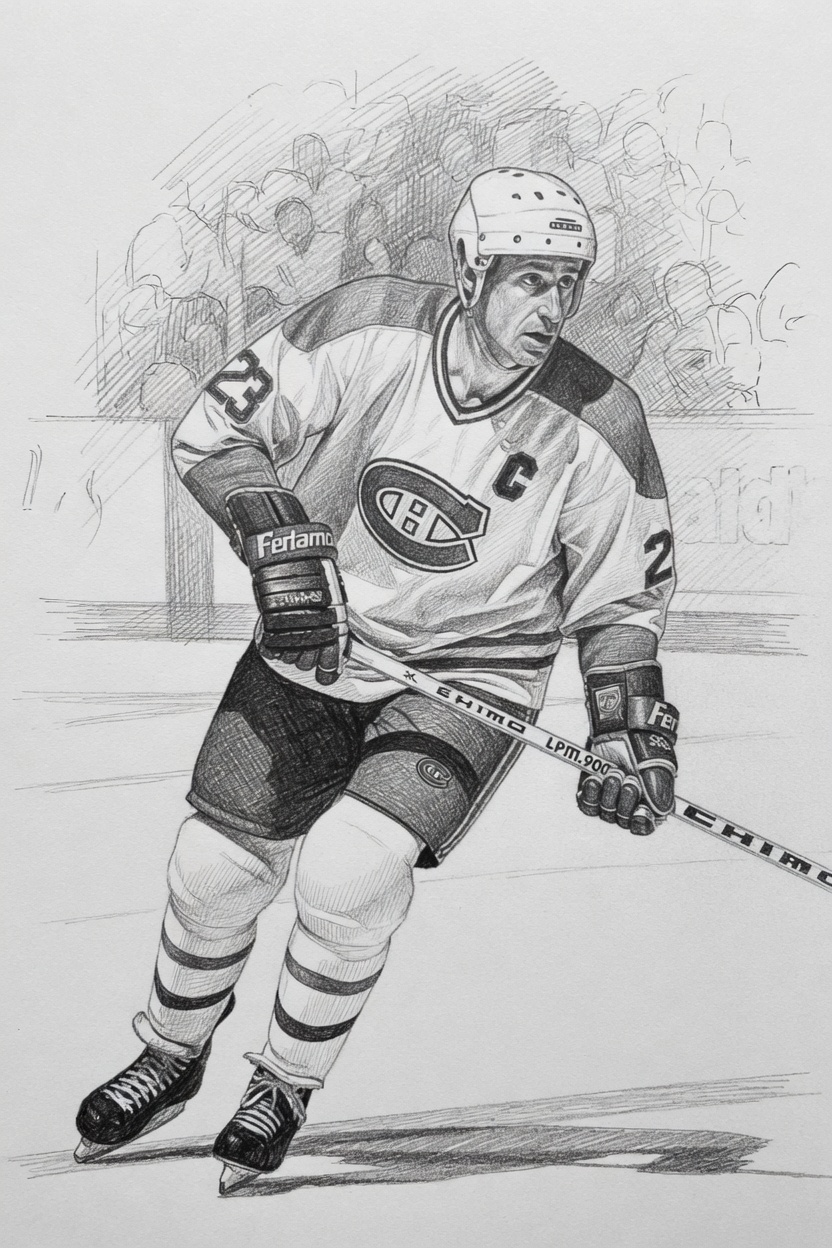
Bob Gainey is not an accidental Hall of Famer, but was inducted in 1992 at the earliest possible moment, before his management and coaching careers had added any laurels. He has, on multiple occasions, been named one of the 100 best players in NHL history. notwithstanding that he was a less effective offensive player than Steve Tambellini (though a considerably better general manager). Steve Shutt: “There are a lot of defensive forwards in the league, but he is the only one who controls a game.” Serge Savard: “I can’t think of anyone on our team who means more to us than Gainey. A few guys like Larry Robinson, Guy Lafleur and Guy Lapointe mean as much. But they’re not more important than Gainey.” The Habs have retired his number. He won five Stanley Cups, one as a captain, the first four Selke Trophies in a row, and a Conn Smythe.
Who cares? Nobody pretends Bob Gainey is in the Hall of Fame for his scoring. His strengths did not show up in statistics and everyone knew it. He was a durable leader with first-rate intelligence, strong physical play, and an inspiring work ethic; if there was an NHL award for intangibles Gainey would have won it every year until the voters got sick of him, and arguably that’s what those Selkes in fact were. And Gainey’s teams won. He was obviously a useful player, but realize just how vast a problem his scoring is. Offensively, he does not belong in the conversation with any other Hall-of-Fame forward. He is not close; he is not close to being close. Over the highest-scoring era in hockey history, Bob Gainey was an average to below-average scoring forward. To be a Hockey Hall of Fame-quality player, he would have to be so good defensively as to make up for that. Today, we know that is probably impossible. Defensive forwards are not that valuable, and Bob Gainey simply wasn’t extraordinary enough to be the exception.
Here are Gainey’s career statistics with a few advanced statistics tacked onto the right. Put a pin in them, they’ll be important1.
| Bob Gainey | ||||||||||||
| Season | Age | Team | GP | G | A | Pts | +/- | PIM | SOG | OPS | DPS | PS |
| 1973–74 | 20 | Montreal | 66 | 3 | 7 | 10 | -9 | 34 | 55 | -1.7 | 0.3 | -1.3 |
| 1974–75 | 21 | Montreal | 80 | 17 | 20 | 37 | +25 | 49 | 132 | 0.9 | 1.3 | 2.2 |
| 1975–76 | 22 | Montreal | 78 | 15 | 13 | 28 | +20 | 57 | 155 | 0.1 | 1.3 | 1.4 |
| 1976–77 | 23 | Montreal | 80 | 14 | 19 | 33 | +31 | 41 | 143 | 0.6 | 1.2 | 1.8 |
| 1977–78 | 24 | Montreal | 66 | 15 | 16 | 31 | +11 | 57 | 140 | 1.2 | 0.7 | 1.9 |
| 1978–79 | 25 | Montreal | 79 | 20 | 18 | 38 | +12 | 44 | 153 | 1.3 | 1.1 | 2.4 |
| 1979–80 | 26 | Montreal | 64 | 14 | 19 | 33 | -1 | 32 | 153 | 1.1 | 0.7 | 1.8 |
| 1980–81 | 27 | Montreal | 78 | 23 | 24 | 47 | +13 | 36 | 181 | 1.9 | 1.4 | 3.2 |
| 1981–82 | 28 | Montreal | 79 | 21 | 24 | 45 | +36 | 24 | 172 | 1.2 | 1.8 | 3.0 |
| 1982–83 | 29 | Montreal | 80 | 12 | 18 | 30 | +6 | 43 | 149 | -0.1 | 0.9 | 0.8 |
| 1983–84 | 30 | Montreal | 77 | 17 | 22 | 39 | +11 | 41 | 125 | 1.0 | 1.5 | 2.5 |
| 1984–85 | 31 | Montreal | 79 | 19 | 13 | 32 | +14 | 40 | 164 | 0.5 | 1.6 | 2.1 |
| 1985–86 | 32 | Montreal | 80 | 20 | 23 | 43 | +11 | 20 | 133 | 1.3 | 1.4 | 2.7 |
| 1986–87 | 33 | Montreal | 47 | 8 | 8 | 16 | 0 | 19 | 73 | 0.0 | 0.7 | 0.7 |
| 1987–88 | 34 | Montreal | 78 | 11 | 11 | 22 | +8 | 14 | 101 | -0.5 | 1.2 | 0.7 |
| 1988–89 | 35 | Montreal | 49 | 10 | 7 | 17 | +13 | 34 | 66 | 0.1 | 1.0 | 1.1 |
| Total | 1160 | 239 | 262 | 501 | +201 | 585 | 2094 | 8.8 | 18.1 | 26.9 | ||
We are not asking whether Bob Gainey was a good defensive forward because we can be certain that he was. Gainey played 1,160 NHL games with the Montreal Canadiens when they were one of the smartest teams in sports, and if Gainey wasn’t legitimately good defensively he’d have been run out of the league. That Gainey was significantly more valuable than his scoring suggests is the null hypothesis. We are trying to establish whether he was so good defensively to elevate his underwhelming offensive production to a Hall of Fame career.
The case against Bob Gainey as a Hall-of-Fame calibre player can be simplified to three points:
-
We cannot prove that he controlled the game defensively. We don’t have the game data to be definitive, and point shares are a sufficiently flawed system that his poor numbers aren’t proof, but if he generated a ton of very valuable turnovers we’d see them in his assists or his plus/minus; his assists are low relative to his goals, and his plus/minus was steadily around his team’s forward median when they were good.
-
We can strongly suggest that Gainey could have been the best defensive forward of his generation, but that’s not worth that much. His statistics are shaped the same as modern players who we can see the high-resolution details of, and they just weren’t that valuable. There is a “Bob Gainey type,” and it’s Ethan Moreau. A rich man’s Ethan Moreau is not a Hall-of-Fame-level producer. He was not a “two-way forward,” he was almost purely defensive.
-
The unknowns and the intangibles cannot possibly make up the difference. By reputation, Gainey started a lot of his shifts in his own zone. We now know that is a disadvantage to a player’s scoring record, but double his offensive point shares and he’d still have the lowest point shares per 82 games played of a Hall-of-Fame NHL forward. He was a great leader; so was Kelly Buchberger. His many amazing teammates seem to have loved him, but they were also all much more effective than him. Do anything you like to his numbers, give him any adjustment you can dream of: based on what we now know about how little defensive forwards contribute to winning hockey games, Bob Gainey did less than any other Hall-of-Fame forward. The difference in defensive quality between Gainey and the best defensive forwards of the 21st century would have to be about the difference in offensive quality between apex Wayne Gretzky and, say, Pierre Larouche. This would have shown up on the scoreboard somewhere and we would not be having this conversation. It’s just too much.
That “poor man’s Tiger Williams” offense is a massive problem. I recommend Lars Skytte’s statistical analysis of the differences in contributions between forwards and defensemen to anyone willing to look at scatter plots; Skytte’s model suggests that a high-offense low-defense forward is not only more valuable than a low-offense high-defense forward, but enormously more valuable. Skytte’s archetypal defensive forward, writing in 2021, is Riley Nash; well, let’s give Bob Gainey the benefit of the doubt for being better than Riley Nash. According to this model, even if Gainey was a zero rather than a negative offensively (as Nash was), he’d have to be three times more effective than the best defensive forward of 2021 for his contributions to a team’s scoreboard results to match a superstar forward who can’t play D at all. A Hall-of-Fame-level defensive forward needs to be unbelievable, not even the Gretzky of defensive forwards but something we can hardly imagine. This is probably more ground than any man could ever cover.
Enjoyed this? Subscriptions help support future pieces. Support the site