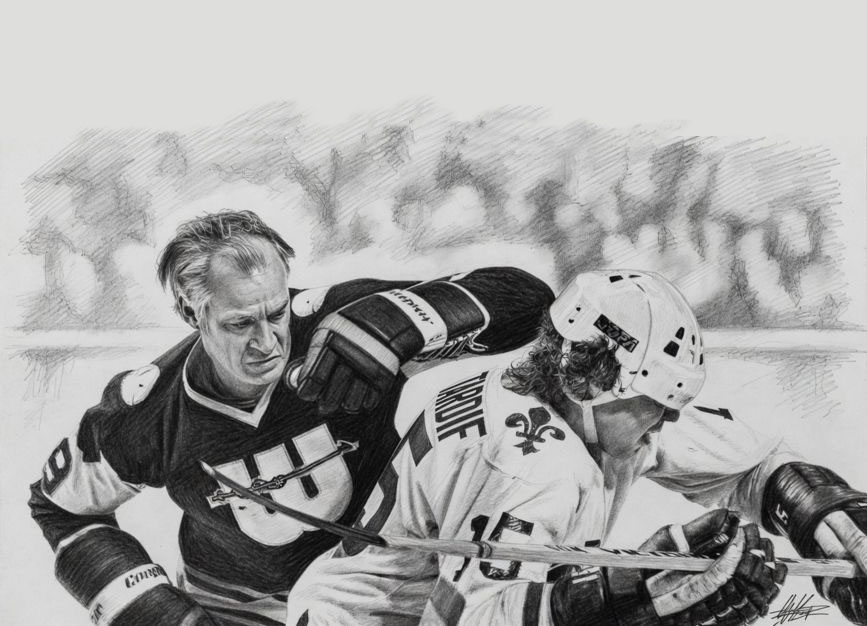
The World Hockey Association (1972–1979) was the one serious attempt to compete with the National Hockey League since the reign of George V. From their first season to the last they had real hockey markets and real stars, beginning with Bobby Hull and ending with Wayne Gretzky. They played exhibitions against the NHL, regular season games against European national teams, and a Summit Series of their own against the Soviets. They tried the shootout, they tried blue pucks, they tried cheerleaders, they tried some of the most flamboyant sweaters in hockey history, name it and they probably tried it. Not coincidentally they embodied a chintzy sleaze of bounced cheques, naming their championship trophy after a financial services company, and playing in some of the worst arenas to allegedly host major-league hockey since the invention of artificial ice.
The year before joining the Winnipeg Jets Bobby Hull had tied for second in the NHL in goals and was seventh in points. Hull was 33 when the WHA began play; so while not nearly washed-up he was entering the downswing of his career. One of the few non-hair-dye users on Hull’s last Black Hawks team was a 26-year-old named André Lacroix, Prior to joining the WHA Lacroix had been an elite, but hardly superlative, junior player, and in five NHL seasons he achieved only a little. Then, in seven WHA seasons, he recorded 251 goals and 798 points in 551 games with a +22, leading the league in all-time scoring, winning two season titles, and being twice named MVP. Returning to the NHL after the merger, he lasted less than a season. Hull scored fewer points, but in fewer games, and with a better points-per-game. Hull won WHA championships; Lacroix never even made a final, though it was hardly his fault. Hull was one of the great shooters of all time, Lacroix a playmaker. You can pick either one for the WHA’s greatest forward, but what does it say about the league to discuss an old, bald man and a definitely second-rate NHLer in such terms?
Was the WHA a major hockey league, not as good as the NHL, but worthy to be held alongside it? In this series I will answer “yes, obviously.” However, the best possible reason for instinctive doubt is the quality of its marquee players. Lacroix, though a pretty good NHL player, was nobody’s idea of a superstar. Hull was, but he was also old. And their best defenseman was J. C. Tremblay, a six-time NHL All-Star and Norris finalist in the Bobby Orr years, but he was 34 when he joined the WHA and put up superstar numbers. Tremblay twice led the whole league in assists and won the best defenseman award, the last at age 36. If your all-time stars, your Alex Ovechkin, Bobby Orr, and Wayne Gretzky, are an old Hull, an old Tremblay, and André Lacroix, can you really be a major league?
In baseball the concept of a “major league” is historically important. There was more major league baseball in its formative years than what we see today, and a handful of long-defunct leagues established records and legends that are still remembered. The American and National Leagues were distinct enough to affect history until, at the latest, 2022. A “major league” is in the record books. Everyone knows that, in 1941, Ted Williams became the last major league player to hit .400 in a season. This record lasted until December 2020, when Major League Baseball announced that the seven historic negro leagues were also major league baseball and the last .400 hitter was therefore Josh Gibson of the 1943 Homestead Grays. Well, nobody much cared for Teddy Ballgame anyway, but the point is that in baseball, the phrase “major league” affects how we view the game in hindsight.
In hockey, it matters rather less. While there were other “major” hockey leagues in the days of the rover, hockey was so different then and the leagues so short-lived that it’s of less interest. Counting the WHA as a major league means you can say “well actually the major league leader in goals scored is still Gordie Howe with 975” and that Alex Ovechkin hasn’t even caught Wayne Gretzky for second, it means that Jim Harrison and not Darryl Sittler had the first major-league ten-point game, it means that Lacroix held the single-season assist record for a hot minute before Gretzky removed all doubt, but it will never be more than trivia. Only the WHA’s most ardent defenders will say that it was as good as the NHL, a more stable league with more great players and more teams. Many WHA stars were flashes in the pan, of the sort the NHL has always had, who stand out because the WHA lasted seven seasons and the NHL has lasted more than a century. The fact that the NHL dominates history is not really unjust. But if the WHA was a major league, it will affect how we view a few things, a few players. You may not come away insisting Gordie Howe was a greater sniper than Alex Ovechkin, but you’ll come away with something.
Baseball’s Union Association is a look at what a major league isn’t1. Playing one season in the 19th century, the Union Association was counted in the encyclopedias as “major league baseball” since at least 1922 and often still is (on baseball-reference.com, for example), but Bill James has made the strong case that it is not. The Union Association played one season, 1884, the brainchild of an odd St. Louis millionaire who like a bad online league commissioner loaded up his team with all the star power available and let the others quit at leisure.
The Union Association had big-league players. James counted 272 players who played at least once in the UA; 179 of them either had no other major league experience or mere cups-of-coffee, there were 53 otherwise-fringe major leaguers, 26 players who had been or would be major-leaguers but were either too old or too young at the time, 14 “legitimate major league players,” and, for James, zero stars2. The WHA did have NHL stars; besides Hull and Tremblay, Gerry Cheevers, Bernie Parent, Derek Sanderson, and Paul Henderson played in the WHA in their prime. But several major-leaguers, in both the UA and WHA, put up numbers way above their otherwise-established level, while no established pros that James could found particularly disappointed in the UA and few did so in the WHA. As James put it:
Doesn’t it seem pretty obvious what the level of competition in that league was? It was a league that made .270 hitters into .400 hitters, and .450 pitchers into Sandy Koufax. In modern baseball, Al Martin is a career .280 hitter. Let me ask you: if there was a new league now, and if Al Martin hit .400 in that league, and Donovan Osborne went 23–4, would you accept that as a major league?3
A major league, to Bill James, does not turn major league mediocrities into superstars. Did the WHA turn mediocrities into superstars? Before answering we have to note that the WHA was a higher-scoring league than the NHL; about 10% more goals per game4. There were a few reasons for this: the WHA, seeking fan attention, was more likely to give big money to an offensive star than a defensive one5, the WHA tended to play in smaller, eccentric rinks that favoured goal-scoring, the WHA legalized a greater curve on stick blades than the NHL did (basically to make Bobby Hull happy), and much of the WHA’s star power was tied up in teenagers, who tend to be effective offensive players before they’re effective defensive ones. However, the WHA numbers, while higher than the NHL’s, were not gaudy: it was only once as much as a goal per game. By 1980–81, there were as many goals in the NHL as there had been in the WHA, and in the eighties it only went up from there.
Applying the WHA-to-NHL point adjustment to the career of André Lacroix, let’s see what we get. All WHA numbers are adjusted to match the per-game scoring rates in the NHL that season, and just to make sure you don’t forget the WHA numbers are in italics.
| André Lacroix | |||||||
| Season | Team | League | Age | GP | G | A | Pts |
| 1967–68 | Philadelphia | NHL | 22 | 18 | 6 | 8 | 14 |
| 1968–69 | Philadelphia | NHL | 23 | 75 | 24 | 32 | 56 |
| 1969–70 | Philadelphia | NHL | 24 | 74 | 22 | 36 | 58 |
| 1970–71 | Philadelphia | NHL | 25 | 78 | 20 | 22 | 42 |
| 1971–72 | Chicago | NHL | 26 | 51 | 4 | 7 | 11 |
| 1972–73 | Philadelphia | WHA | 27 | 78 | 46 | 68 | 114 |
| 1973–74 | New York/New Jersey | WHA | 28 | 78 | 27 | 70 | 97 |
| 1974–75 | San Diego | WHA | 29 | 80 | 38 | 98 | 136 |
| 1975–76 | San Diego | WHA | 30 | 80 | 26 | 66 | 92 |
| 1976–77 | San Diego | WHA | 31 | 81 | 29 | 74 | 103 |
| 1977–78 | Houston | WHA | 32 | 78 | 30 | 65 | 95 |
| 1978–79 | New England | WHA | 33 | 78 | 30 | 53 | 83 |
| 1979–80 | Hartford | NHL | 34 | 29 | 3 | 14 | 17 |
Set aside Chicago as a disaster; Danny O’Shea, Lou Angotti, and Eric Nesterenko outperformed Lacroix there and were nowhere near as good as him in the WHA. Then, Lacroix’s adjusted improvement in the WHA is very large but less unreal. Though Lacroix washed out of the NHL rather abruptly after the merger, he was ’80s Old and even so a half-point-per-game player. Before this, Lacroix’s NHL teams tended to be projects. Lacroix led the Flyers in scoring in 1968–69 and 1969–70, not that it was much to be proud of since they were terrible, but he was top-30 in NHL scoring both years. When Bobby Clarke got good he bumped Lacroix down the depth chart but fair enough, it was Bobby Clarke. Even then, Lacroix was a darned useful second line player and actually contributed more on the power play than Clarke did.
Enjoyed this? Subscriptions help support future pieces. Support the site