Skip to content

How Good Was the WHA?

How Good Was the WHA: Major League Teams

We've seen that the calibre of the World Hockey Association's top stars was high enough to call the WHA major league hockey. But hockey is not a superstar game. J. C. Tremblay was a great player; him and five AHLers make a good AHL defense. Your team would get smoked by the worst team in the NHL in a seven-game series and nothing Tremblay could do would make much difference. How can we judge how good the actual teams, from Bobby Hull down to the worst fourth-line goon, actually were compared to the NHL?

Just on the off chance a young person is reading this, I'll tell you something old WHA fans know: the one way you must not answer this question is by looking at what the four WHA teams accepted into the NHL did there. The NHL-WHA merger is often called a "surrender," where the NHL teams ruthlessly pillaged the WHA of their talent. It was a bit better than that; the WHA teams were permitted to keep three to four players officially, and in practice kept many more as the NHL's hard line softened once it was official that they'd actually have to share a business with these guys. True, there was some lingering NHL spite: making the WHA teams pick last in the Entry Draft rather than first, and denying Wayne Gretzky the Calder trophy on the grounds that he already had major-league experience. This did not wind up hurting that much: of the four Hall-of-Famers selected in the first round in 1979, two went to WHA teams (Michel Goulet to the Nords and Kevin Lowe to the Oilers), and Gretzky's legacy is fairly safe. They lost most of their top stars, but not all of them, and the NHL honoured Gretzky's personal services contract with Peter Pocklington rather than fight it. They were more like "expansion teams plus" than true expansion teams. Only the Quebec Nordiques finished last in their division their first year in the NHL, and they weren't a bad last. However, what they weren't was representative of the teams as they played in the WHA.

Going through each player on each roster would be more noise than signal. If you can compare half-century-old third-liners across two different leagues statistically and come out with a comprehensible result you are a better man than I. In baseball you can look at a guy who hit .280 and the pitching he faced and say something; in hockey ice time matters and we don't know it. There isn't enough video for even objective comparisons, and who'd have the time to watch it if there was? What we want is a corpus of how WHA teams played against NHL teams, or teams that NHL teams can otherwise be compared to; very fortunately, we have it.

Continue reading

How Good Was the WHA: The Top Players

The World Hockey Association (1972–1979) was the one serious attempt to compete with the National Hockey League since the reign of George V. From their first season to the last they had real hockey markets and real stars, beginning with Bobby Hull and ending with Wayne Gretzky. They played exhibitions against the NHL, regular season games against European national teams, and a Summit Series of their own against the Soviets. They tried the shootout, they tried blue pucks, they tried cheerleaders, they tried some of the most flamboyant sweaters in hockey history, name it and they probably tried it. Not coincidentally they embodied a chintzy sleaze of bounced cheques, naming their championship trophy after a financial services company, and playing in some of the worst arenas to allegedly host major-league hockey since the invention of artificial ice.

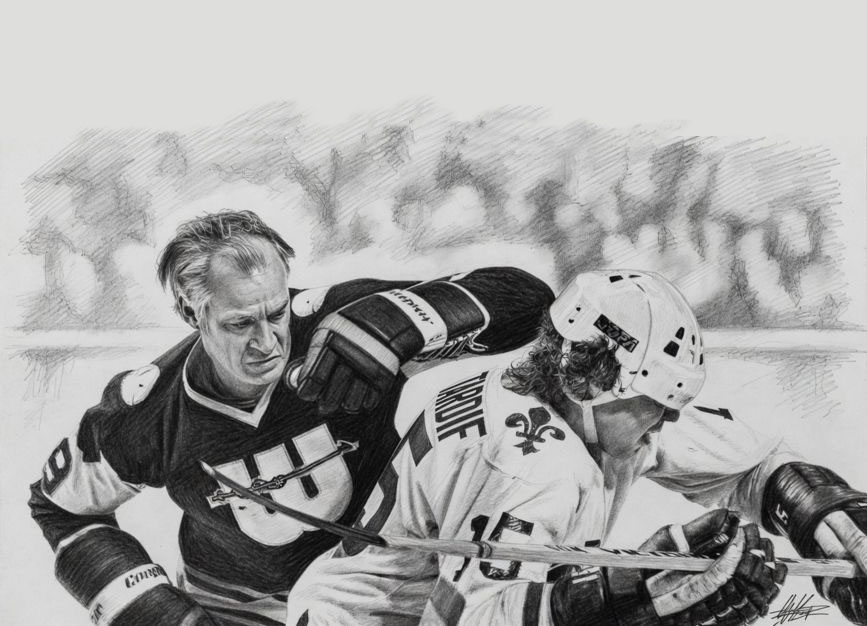
The year before joining the Winnipeg Jets Bobby Hull had tied for second in the NHL in goals and was seventh in points. Hull was 33 when the WHA began play; so while not nearly washed-up he was entering the downswing of his career. One of the few non-hair-dye users on Hull's last Black Hawks team was a 26-year-old named André Lacroix, Prior to joining the WHA Lacroix had been an elite, but hardly superlative, junior player, and in five NHL seasons he achieved only a little. Then, in seven WHA seasons, he recorded 251 goals and 798 points in 551 games with a +22, leading the league in all-time scoring, winning two season titles, and being twice named MVP. Returning to the NHL after the merger, he lasted less than a season. Hull scored fewer points, but in fewer games, and with a better points-per-game. Hull won WHA championships; Lacroix never even made a final, though it was hardly his fault. Hull was one of the great shooters of all time, Lacroix a playmaker. You can pick either one for the WHA's greatest forward, but what does it say about the league to discuss an old, bald man and a definitely second-rate NHLer in such terms?

Was the WHA a major hockey league, not as good as the NHL, but worthy to be held alongside it? In this series I will answer "yes, obviously." However, the best possible reason for instinctive doubt is the quality of its marquee players. Lacroix, though a pretty good NHL player, was nobody's idea of a superstar. Hull was, but he was also old. And their best defenseman was J. C. Tremblay, a six-time NHL All-Star and Norris finalist in the Bobby Orr years, but he was 34 when he joined the WHA and put up superstar numbers. Tremblay twice led the whole league in assists and won the best defenseman award, the last at age 36. If your all-time stars, your Alex Ovechkin, Bobby Orr, and Wayne Gretzky, are an old Hull, an old Tremblay, and André Lacroix, can you really be a major league?

Continue reading