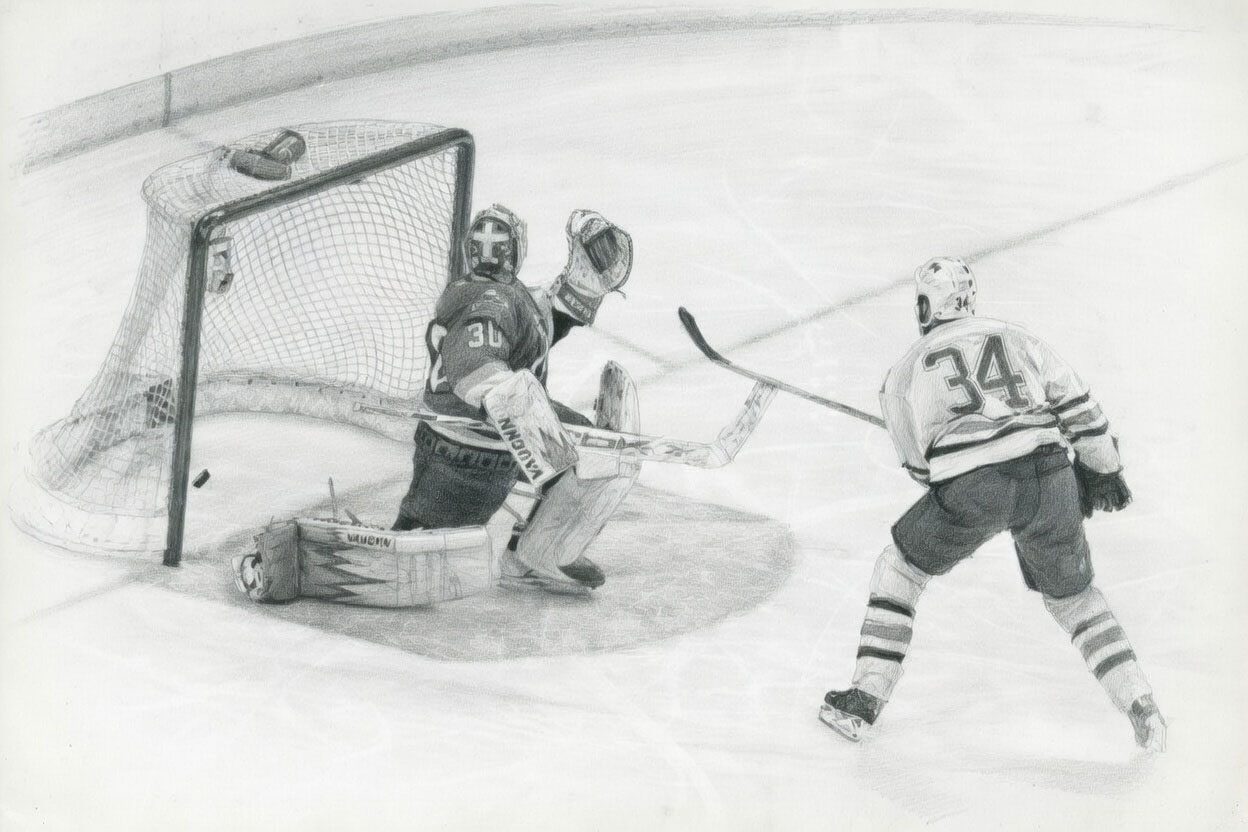
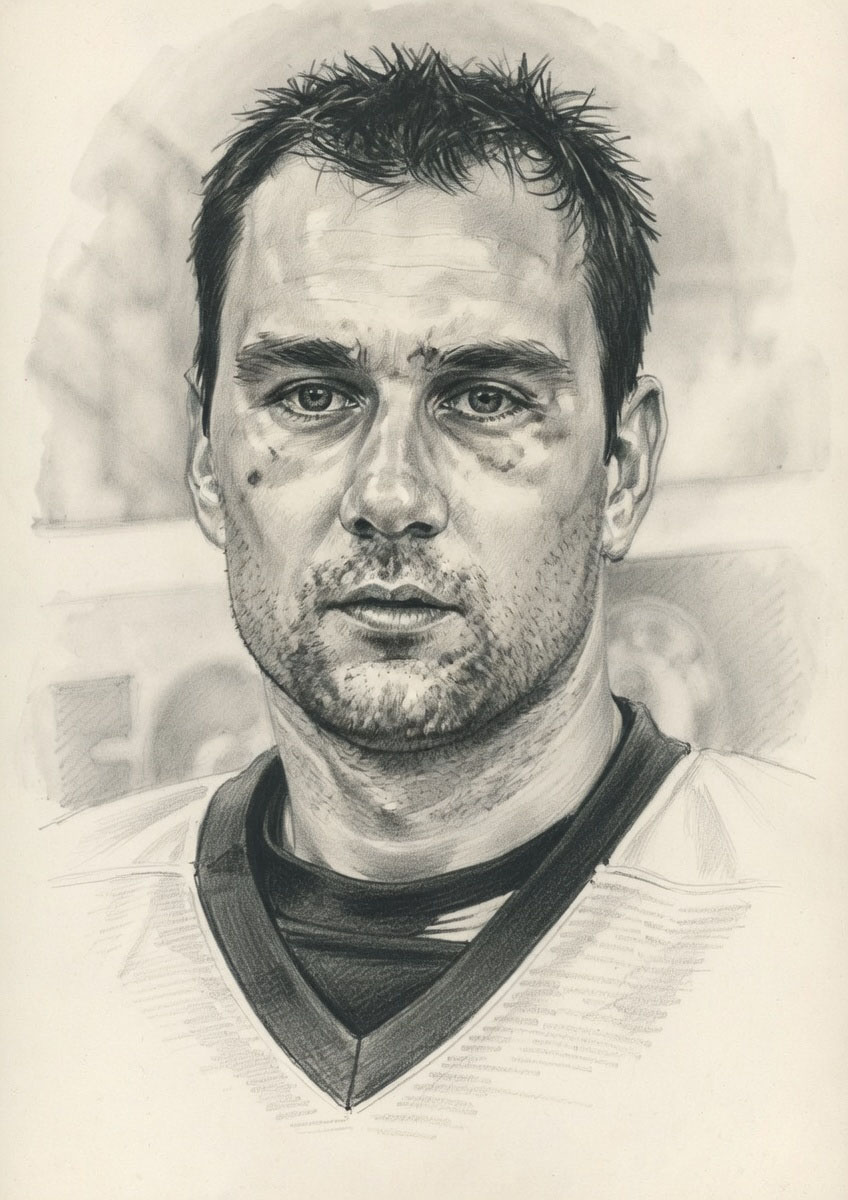
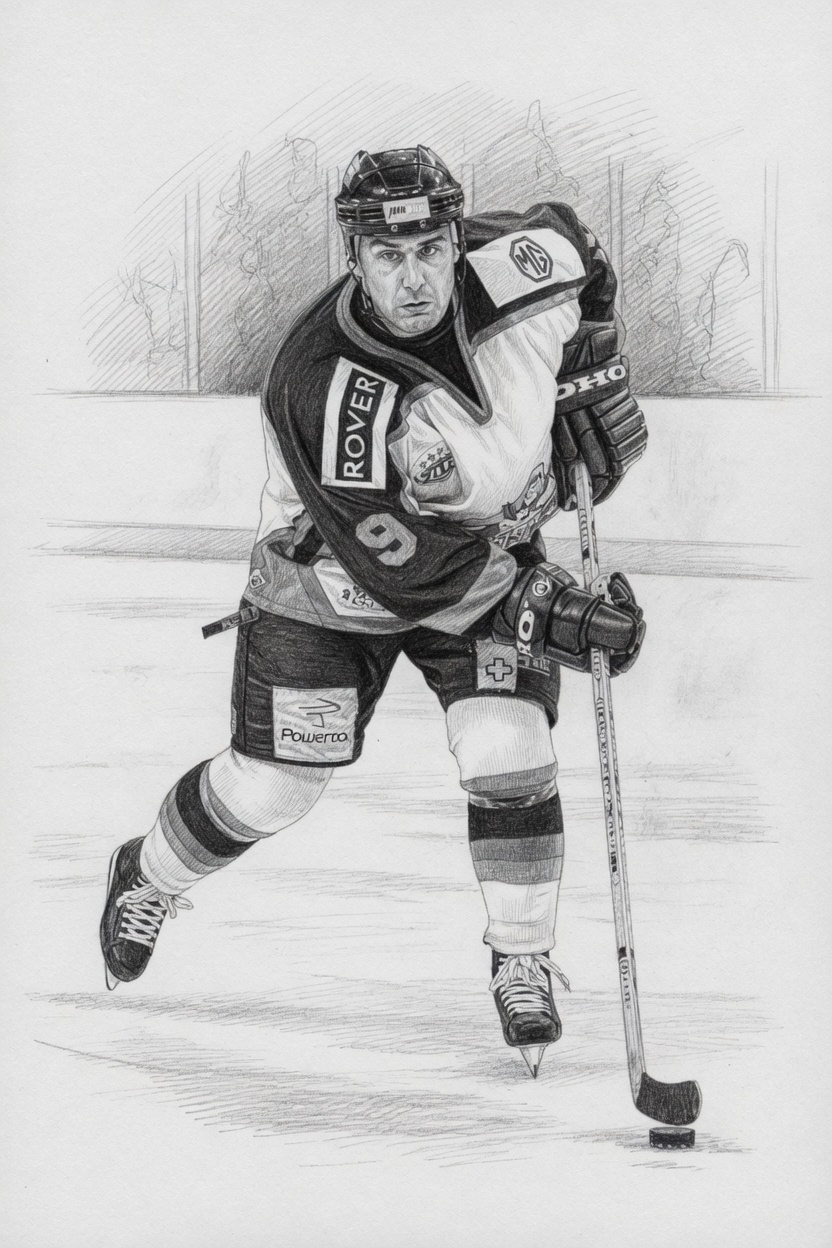
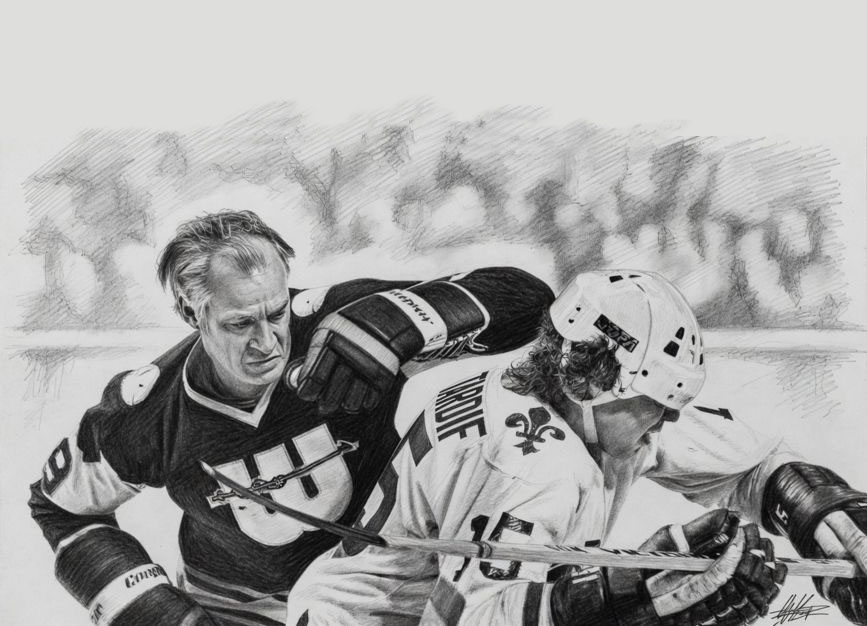
Anthony Hand MBE (August 15, 1967 –) is the greatest British born-and-bred ice hockey player of all time. This is not a vividly hot take; one might as controversially say that Patrick O’Brian liked ships. In British-trained hockey Hand is first and the rest nowhere. Liam Kirk, the best British-trained player of the twenty-first century to date, may make it an argument before the end, but Hand has all the qualities of a legendary player for a bottom-rate team: a lack of international success, a great deal of personal recognition for his talent, and an enormously long career. Hand was active in top-division British hockey, with interruptions, from 1983 to 2009, played in the second division until 2015, and although statistics are unreliable is probably the all-time leading scorer of the old British League.
Born, raised, and whenever he could get away with it professionally based in Edinburgh, Hand is best remembered for having been drafted 252nd and last overall in 1986 by the Edmonton Oilers; the first British-trained player ever selected in an NHL Entry Draft, supposedly on the suggestion of former Oiler Garry Unger, who played a few years in England to close out his stat book. Attending a couple training camps with one of the best offensive teams in hockey history, Hand did well enough to seriously interest Glen Sather in giving him a minor-league deal, but Hand was homesick and, apart from a short but successful spell with the WHL’s Victoria Cougars and a second strong training camp, played his entire professional career in England and Scotland. Whenever one hears the story of Tony Hand, one will hear Glen Sather’s quote that Hand “was the smartest player [in Oilers camp] other than Wayne Gretzky.” Small wonder he is known as “the Scottish Gretzky.”
But really, how good was he? Hand played three league games outside of Great Britain, and those were as a junior. His British career was immense and successful but coincided with the all-time nadir of British international hockey, where the Brits were at times as low as the fourth division of the World Championships with the likes of New Zealand and Spain. Hand led a modest resurgence, culminating to a glorious top-pool appearance at the 1994 World Championships, but Hand failed to score, the Brits lost all five of their games, and never managed to escape the second division during the rest of Hand’s career, though they were sometimes quite good there.
Hand has enjoyed a modest prominence in the past few years. When I wrote about Hand fifteen years ago1, I spent a lot of time scrapping around weird British hockey forums to find information. The next spring TSN ran a short segment on Hand as part of their NHL Entry Draft coverage, and his interesting story came up to the next generation, who resurrect his career here and there through TikToks and YouTube features. The Hockey News had a short article on him on the occasion of his playing retirement and he is the subject of a 2024 documentary, The Other Side of Edinburgh, that has a limited online release. He was inducted into the British Ice Hockey Hall of Fame in 2016 and, as a holder of the Torriani Award, the IIHF Hall of Fame in the 2017. If that sounds a little late in the day it’s because Hand only stopped bloody playing after the 2014–15 season, when he was the third-leading scorer for second-division Manchester Phoenix at age 47.
Hand’s resume as the best British-trained player, and one of the few best British players overall, is based substantially off longevity and a romantic legend, with comparisons to Gretzky and constant thoughts of the difficult road he chose not to take2. He turned down two chances to play serious hockey overseas when he was in his teens, and may not have had another. Wikipedia claims that in his late 20s he was offered a place with HPK of the Finnish league, but does not cite a source and the story seems impossible to back up these days. For Hand, we’re dealing with a lot of “might-have-beens” and a woeful sample of first-class games:
-
Three games with the 1986–87 Victoria Cougars of the WHL. Hand played superbly, with eight points, but returned home to Scotland. Victoria wanted him back, that season or the next, but he was homesick and didn’t care for the intensity of major junior hockey3.
-
The 1994 World Championships, the only time Great Britain played at the top level during Hand’s career. The Brits lost all six games heavily and Hand, 27 years old and fresh off his best-ever 222 point season, was pointless.
Three WHL games obviously prove nothing either way. Six games in the 1994 World prove twice nothing. Hand was very good in the WHL and disappointing in the Worlds. The 1994 World Championships were the biggest stage Hand had ever or would ever play on, the only time he felt any pressure beyond the rather limited British hockey fanbase. He did not acquit himself well, though his entire team was way out of its depth, and their best overall game was probably their 8–2 loss to Canada. That Hand disappointed on the big stage is a fact; however, it hardly defines so long a career.
To assess Hand’s quality, we have to to consider what he did in Britain. Fortunately, enough fairly-notable players crossed Hand’s path at enough points for us to attempt to piece together a picture. Center Ken Priestlay was a teammate of Hand’s first in Victoria and then in Sheffield. In-between he had a fairly good go of a North American pro career, including 61 points in 168 NHL games with Buffalo and Pittsburgh and a tour with Father Bauer’s Canadian national team. Priestlay was a player we can all picture, a little skilled guy who really wasn’t quite skilled enough to stick in the show but deserved his shot and probably had lots of fans saying he was underrated. He and Hand were born nine days apart and Priestlay was a teammate of Hand’s in Sheffield for four seasons, an unusually good sample.
Priestlay’s first year alongside Hand was the last of the old British League (usually called the BHL) a mostly-domestic circuit with the good players putting up scores better suited for pinball machines. Hand played in the BHL for a decade, mostly for his local Edinburgh team, led his team in scoring every year but his first, often by preposterous margins, won a league scoring title, and was top ten a few other times. He was not dominant in the BHL, though he was very good, and accumulated his all-time record with consistency and longevity in a league that seldom paid enough to live on, seldom attracted foreign players of any quality for more than a season or two, and frankly was somewhat silly.





Enjoyed this? Subscriptions help support future pieces. Support the site