Skip to content

How Good Was Vsevolod Bobrov?

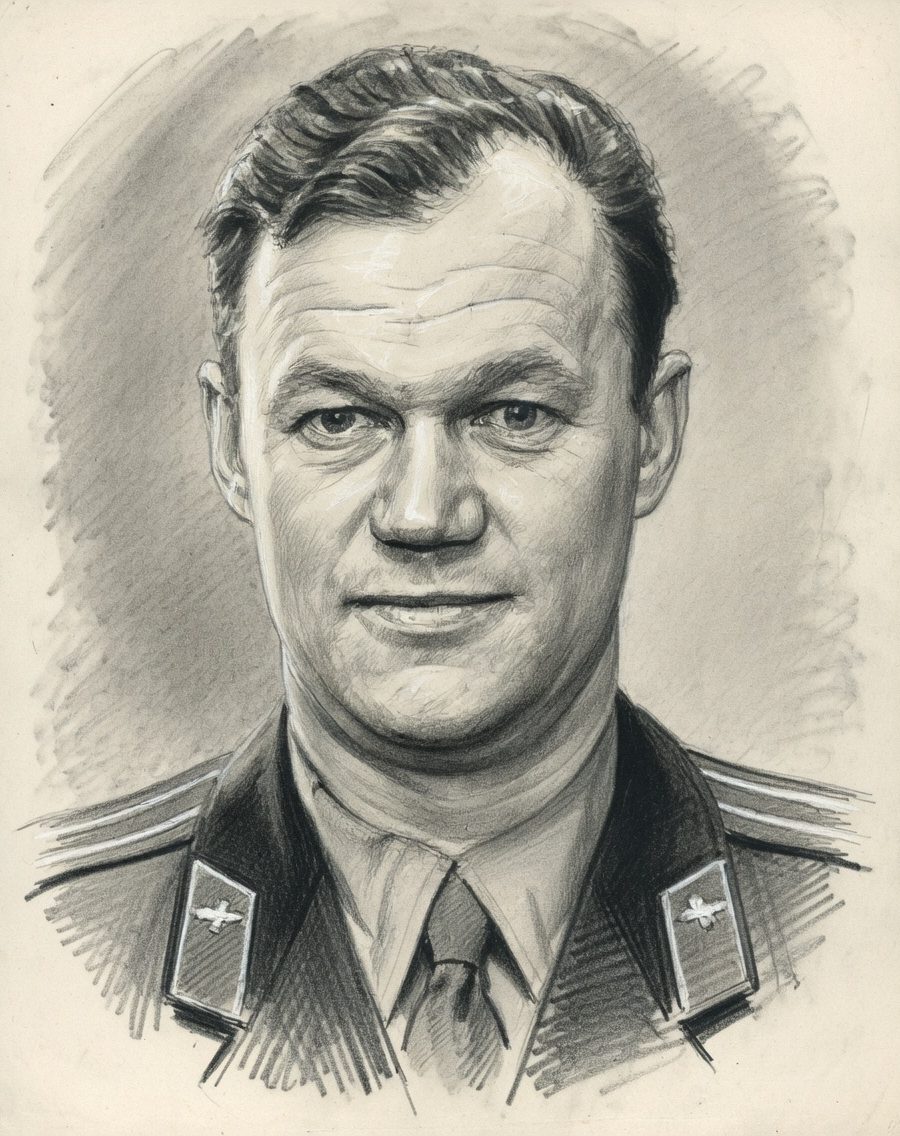
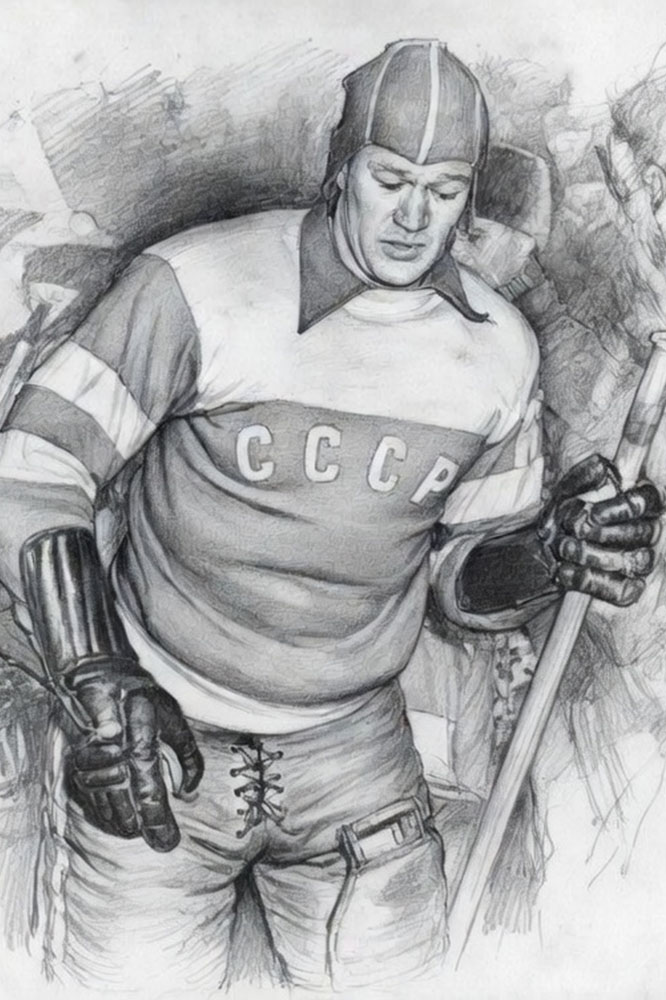
Vsevolod Mikhailovich Bobrov (December 1, 1922 – July 1, 1979) is the official first hockey hero of the Soviet Union, to the extent Soviet hockey went in for anything as bourgeoisie as heroism. The “Big Red Machine,” the formless, perfectly-engineered game-winning communist automaton, all wheels and cogs and interchangeable parts cast in the foundries of the Red Army, was one-third real, one-third the team’s goal, and one-third a contrast to North American individualism that appeared starker than it was. The men, like Bobrov, were still men: they lived and breathed and often enough partied like hellions, flying through the snow in their Ladas with a quart of vodka in the system and smoking Polish cigarettes, differentiated from Guy Lafleur by haircut and quality of goods. They left enough memories that Bobrov was named to the IIHF Hall of Fame on its founding a quarter-century after his death, was named to the IIHF “All-Time Russia Team” in 2020, and the KHL named one of its divisions after him.

Although a well-known Soviet athlete immediately after the war, Bobrov made his first international impact at the Olympics. The Summer Olympics, to be specific; in addition to hockey and bandy (which is to hockey as Pravda is to truth), Bobrov was an excellent soccer forward and captained the Soviet soccer team at the 1952 Summer Olympics. Bobrov began by scoring the equalizer in a 2-1 extra time preliminary-round win against a decent Bulgarian team lead by influential goalkeeper Apostol Sokolov. But that was nothing: the Soviets faced a good Yugoslav team next in the first round proper. Yugoslavia took a 3-0 lead at halftime; while Bobrov was able to make it 3–1 Yugoslavia got the next two to stake a 5–1 lead and, like Tito taking over Albania, they probably thought it was all over. At 75′ Vasili Trofimov scored for the Soviets; Bobrov added his second at 77′ to make a game of it, then completed his hat trick on 87′. 5–4. Aleksandr Petrov tied the game in the eighty-ninth of ninety minutes, and the Soviet Union had what match referee Arthur Ellis called “the most honourable draw ever recorded.” There were no penalty shootouts in those days, so two days later they played again: Bobrov opened the scoring in the sixth minute, but the Yugoslavs took control after that, winning 3-1 and going on to the silver medal, losing only to Ferenc Puskás’s unstoppable Hungarian “Magical Magyars.” Ellis said of Bobrov, “he, almost single-handed, took the score to 5–5 [. . .] For once, use of the word sensational was justified.”

This, it will be remembered, was Bobrov’s second-best sport.

They say, and this is always the mark of quality historiography when talking about Joseph Stalin, but they say Stalin expected a gold medal in soccer in 1952. He had clearly never heard of Puskás then, but losing to Tito’s Yugoslavs, with whom there was bad blood, was ill-advised no matter how many comeback heroics went with it. At any rate, the Soviet coach was officially disgraced and most of the 1952 team, including Bobrov, never played for the national soccer team again. Luckily Bobrov had a better-than-usual plan “B.”

Hockey has been played in Russia since the nineteenth century1 but was not taken up seriously in preference to bandy, the national ice-and-ball game, until after the Second World War. As many regimes have done in many sports, Soviet officialdom saw a game to which its people were well-suited, and had prestigious international competition, but where relatively few countries were competitive, and decided to build a hockey program out of whole cloth.

For many years players crossed over with soccer; the greatest Soviet soccer star of them all, goalkeeper Lev Yashin, faced Bobrov in the Soviet hockey league until 1953. Bobrov started out with the Air Force hockey team, VVS, the fiefdom of Joseph Stalin’s no-good son Vasily. If you haven’t seen The Death of Stalin, you should, and if you have you will remember Vasily’s travails trying to cover up losing an entire hockey team in a plane crash by replacing them with a band of incompetents. It ain’t easy to be unfair to Vasily Stalin but that sequence managed it: the crash spared Bobrov, not only the best player in Russia but a personal friend, who overslept for the ill-fated flight, and Viktor Shuvalov, a scoring champion who did not travel because of injury. It also turns out that Vasily Stalin had a connection or two and his replacements for the deceased players were in fact, by domestic standards, first-rate. Stalin junior’s VVS team won the next three Soviet titles after the plane crash before Stalin senior died in March 1953. VVS lost its patronage instantly; the Soviet authorities disbanded the Air Force team and concentrated their strength at a team that would be named CSKA Moscow but remembered as “Red Army.”2

The early Soviet league must have been an interesting place. Their approach was familiar: teams would be made up of employees of some factory, or some government institution, and then play each other. Hockey was not their job, assembling boots or writing five-year-plans or whatever was, and the players were amateurs linked by a common institution. Even in the West this was a routine way to run a league until the Second World War.

But in the Soviet Union institutions such as the Red Army or the KGB had certain advantages over the tractor factory. Bobrov, for example, was essentially a professional athlete from 1946 to 1954, though nominally an officer in the Soviet military. There was a rigid, dare I say mock-imperialist, rank structure. Bobrov had actually been active during the war; he had served behind the lines as an enlisted man. As a hockey player Bobrov was suddenly officer material, if not a great specimen of it: the country’s best hockey player was a mere lieutenant for nearly a decade. Coaches were a different story, and upon moving behind the bench Bobrov found promotion coming fast and was able to retire a full colonel despite the fact that, by all accounts, Bobrov was not actually a very good coach (if Canada had swept the Soviets in 1972 they’d have made him a brigadier).

This had predictable effects on league parity. Moscow teams won every Soviet championship. Until Gorbachev ruined everything that usually meant the Red Army, with the Ministry of the Interior (i.e. the KGB)’s Moscow Dynamo a distant second. The Air Force won three times in a row during the happy Stalin years, and every now and then a Moscow team of all-star electricians or aircraft builders or something would sneak a title to keep proletarian appearances up.

In the early years seasons were as short as 15 games, at a time when the NHL played 60 or 70 plus playoffs. Until the mid-1950s, all Soviet games were played outdoors, and the best players scored by the snowshovelful. In 1950–51 Bobrov’s VVS Moscow Air Force team scored 117 goals in 15 games, an average of 7.8 goals per game, and allowed only 27. Bobrov himself scored 42 goals, or 2.8 goals per game. He repeated as goalscoring champion in 1951–52 with 37 goals in 16 games; 2.3 goals per game if Bobrov played every game of the season which he probably didn’t. His linemate Shuvalov came second with 313. By comparison, Gordie Howe scored 43 then 47 goals in 70 games as the best goalscorer in the NHL those years.

Multi-sport athletes, wildly uncompetitive play, short schedules, goals galore; Soviet hockey in this era was in a rather primitive state. It bears comparison to the first season of the NHL, 1917–18, where teams played a 22-game schedule and Joe Malone led the circuit with 44 goals in 20 games (2.2 goals per game). If you could have seen one of those games you’d hardly recognize it. On top of his 44 goals, Malone had four assists, which even remembering that the secondary assist hadn’t been invented yet reminds us of how different the game was. All three of the top NHL individual seasons for goals-per-game came in its first year, 1917–18.

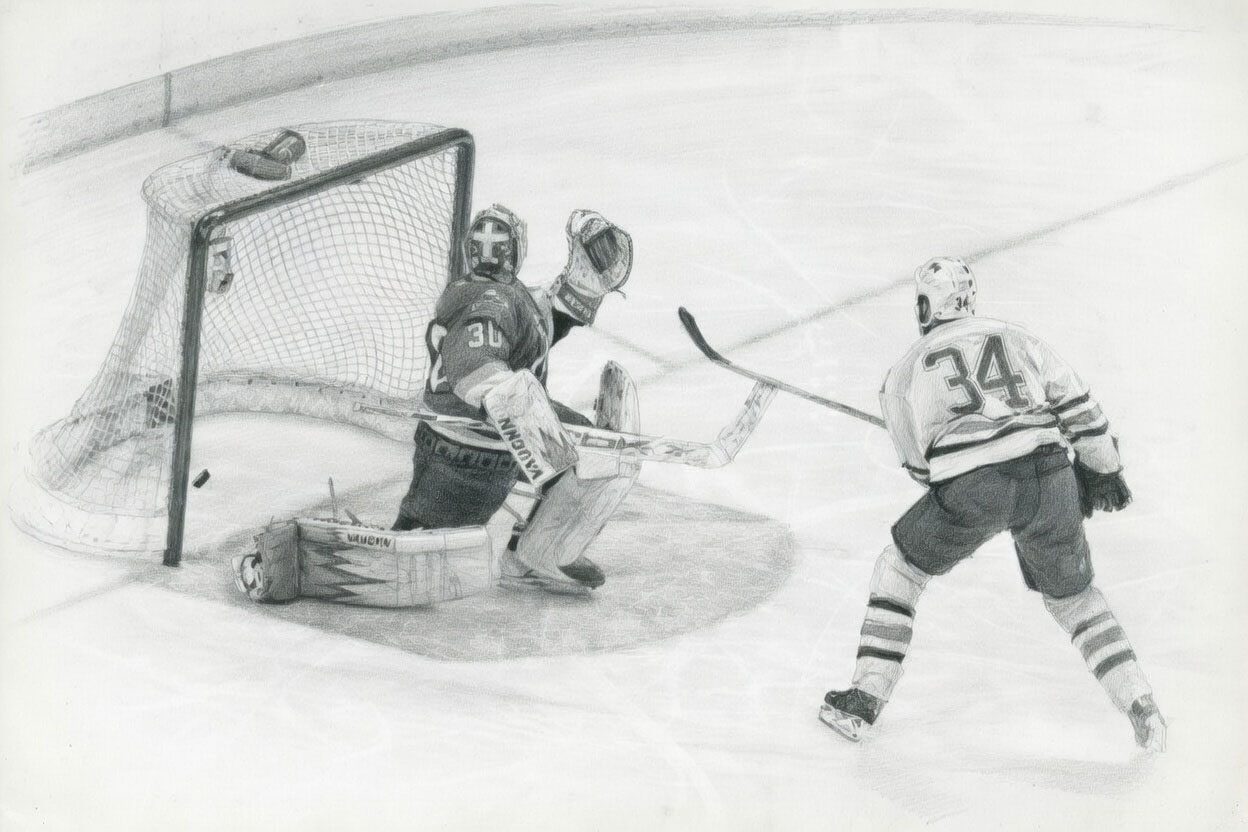
Such outrageous scoring in a top division is a symptom of lower-level hockey. No NHLer has averaged a goal per game while playing in at least 75% of his team’s games since Brett Hull in 1990–91. Since then it has happened 32 times in Canadian major junior, as recently as last season4. Major junior is an apt comparison because most of these players were too young for the next level, either pre-draft phenoms of the Crosby/Tavares type or older players below the NHL level but not yet eligible for the minors; they were stuck where they were. It has never happened in the KHL, and it has happened once in the AHL (Brad Smyth, 1995–96; 68G, 68GP). If there’s a “higher league” to go to, a player good enough to score like that goes to it: if it happens in your top league, your top league is not very top. This, again, is one goal per game. In his good years Bobrov averaged well over two, and he was not alone.

In his best years, Bobrov scored like Joe Malone in his best years, and even if he did it when half of pro hockey still had the rover, Joe Malone is a Hockey Hall of Famer. Like Malone, there was no higher league for Bobrov; you may recall that the Soviet Union had some rather old-fashioned ideas about freedom of movement. But Bobrov’s era was the 1950s, when the NHL was recognizably modern, and Gordie Howe was active; the Soviets were developing fast but were still decades behind. Based on the obvious primitiveness of Soviet hockey at this time, you can’t say Bobrov was clearly a great player by the highest standards, any more than you can say Frank Banham or René Corbet were for their major junior prowess.

But, of course, Bobrov had international hockey. In 1954 the Soviet Union entered the World Hockey Championships for the first time and, the short version of history agrees, stunned the world by beating Canada 7–2 in the final game to take a debut gold medal. Bobrov scored the game-winner and added an assist; in the tournament he was the Soviet Union’s top scorer with eight goals and three assists and was named best forward. He was, however, only fifth-top scorer in the tournament, and fifth with a bullet: the leading scorer was Canada’s Moe Galand, with 16 goals and 4 assists5.

“This was the Soviet Union,” you protest. “Everyone knows that Canada played as an undisciplined capitalist mob, with every man for himself, while the Soviets embraced the team-first the-individual-nowhere philosophy that won them the Cold War, ruthlessly drilled and greater than the sum of their parts.” But Canada scored 22 more goals than the Soviet Union and had a goal differential 20 goals better—in seven games.

The Soviets dominated on the day when it counted, and for Bobrov to be named best forward when Galand scored twice as many goals suggests he must have been impressive. Sure enough, there is a Russian highlight video of the final game online: the Soviets look good and Bobrov (#9 red) catches the eye every time he’s on the puck; his goal is a gem. On the other hand, defying stereotype, that is not-infrequently because Bobrov tries to do it all himself. Moreover, Canada looks clumsy: fanning on the puck, losing it in their skates under not much pressure, blind passes into crowds in front of their own net, an entire team of Janne Niinimaas. Canada is trying to pass, they’re just not any good at it today, and the Soviets are obviously on their game and comfortable on the outdoor rink with its visible piles of snow on the boards. One expects the Soviet highlight video to flatter the Soviets but Canada looks rough. By the end of the game Canada is exhausted and demoralized, with no recognizable defensive structure; they look like a mid-rate senior team.

This is because Canada was a mid-rate senior team, the East York Lyndhursts, a senior “B” team that had finished third in the Toronto Ice Hockey League. No senior “A” team was willing to make the trip to Finland, nor any higher-finishing senior “B” team, so the Lyndhursts got the job. They were beefed up with a few ringers: Bill Shill had played parts of three seasons with the Boston Bruins, though he was now otherwise out of serious hockey, scored a consolation goal in the final game, and was the tournament’s second-top scorer, 27-year-old Eric Unger had played minor pro. Tom Jamieson played senior “A” in Quebec for a couple years and spent a few not-especially-remarkable seasons in British hockey. Doug Chapman had played major junior. Most importantly, Don Lockhart was an established senior “A” goalie. The standard of Canada’s World Championships teams in the amateur era was pretty mixed; this was not one of the good ones.

The style of play was different in Europe, even compared to today: under international rules the attacking team was not permitted to hit in the offensive zone. Canadians were routinely attacked by the European press for their aggressive bodychecking, while Europeans were in turn criticized by Canadians for their aggressive stickwork and what we’d today call obstruction. The outdoor rinks have been mentioned, at a time when in Canada even senior teams usually played indoors although as kids of course all the Canadians had played outside. But the dimensions of the rink were all over the place, from a substantial portion of a soccer field at one World Championships to even a bit smaller than an NHL rink at another.

That Canadian team would not have won the Allan Cup, let alone competed at a professional level. Shill, six years removed from an honestly lousy NHL career, and Galand, who was only 24 and from his senior stats probably could have played minor pro if he’d wanted to, were the standouts, and both heavily outscored Bobrov. In the final game Bobrov scored, and so did Galand, and so did Shill. There is an idea that, in the Original Six era, senior hockey was stacked with players who had NHL skills but lacked either the opportunity or the patience to make the show, but it does not appear to be true. Players of the most middling minor-pro credentials could dominate senior hockey, while future regular minor-pros would use an Allan Cup-level team to start their adult careers the same way one would the ECHL today.6 Senior hockey was popular, bu because in the years before expansion and wall-to-wall TV coverage, senior hockey could draw the thousand-plus fans that justified the time and travel which set it apart from beer-league teams, not because senior hockey players were great.

This is a long-winded attempt to say that Bobrov, in 1954, was one of the best forwards in a competition where the best players proved they were minor-leaguers at best. The one major leaguer in the bunch was washed-up and hadn’t been any good in his prime. No player at that tournament ever established an NHL career, or a minor career that could be considered equivalent to an NHL career. Several established minor-pro quality, and Bobrov belonged in that class; had he been Canadian or American, he could have been a pro, but not an NHL star. He certainly wouldn’t have got a colonel’s tabs out of it.

Bobrov and the Soviets returned to the World Championships in 1955, while Canada sent the Penticton Vees, reigning Allan Cup champions and the powerhouse of the Okanagan Senior League. Penticton boasted a powerful amateur lineup including several legitimate minor pros and two former NHLers: 30-year-old Bill Warwick, who had a couple cups of coffee with the Rangers as a boy during the war, and his older brother Grant, at 33 one of the oldest players in the tournament who’d had a fairly good run with the Rangers, Bruins, and Habs five years earlier. Once again, gold was on the line in the final game between Canada and the Soviet Union: this time, Canada dominated, winning 5–0. Despite missing two games Bobrov was the joint-leading Soviet scorer with his linemate Shuvalov, with five goals and four assists. He was outscored by six Canadians and equal with a seventh; the tournament leader was Bill Warwick with 14 goals and eight assists in eight games.

But Bobrov’s greatest triumph was still to come. In the 1956 Cortina Winter Olympics Bobrov, then aged 33, was again the leading Soviet scorer of the tournament with nine goals and two assists in seven games. Canada was represented by the 1955 Allan Cup champion Kitchener-Waterloo Dutchmen. They must have been good but they were significantly less experienced than Penticton the year before: few real minor pros and a total of one career NHL game from right winger Paul Knox, who depending on who you believe was either the leading- or second-leading scorer for the tournament. It hardly matters, for Bobrov was clearly the class of the competition: the strange format had four teams in Canada’s group against three in the other two, so Canada got to pad their stats against minnows twice while the Soviets only did it once before being drawn down to a championship group. Scoring was low, probably because of the enormous outdoor rink, which can be seen in colour newsreel footage of the final game; supposedly Canada outshot the Soviets 23–9 but Soviet goalie Nikolai Puchkov was lights-out, and thanks to a shocking loss to the United States Canada had needed to pile on the goal difference. The Soviets won.

Though he did not figure in the scoring in this game, Bobrov had added to the evidence that he had the skill to play Canadian senior hockey at a high level.

Bobrov played his last World Championships on home ice in 1957, which hardly figures into the Bobrov mythology. Neither Canada nor the United States participated, protesting the Soviet occupation of Hungary. For the first time ever Bobrov was not the leading Soviet scorer, finishing four points behind Konstantin Loktev, and though the Soviets limped to a surprising second-place, he was a 34-year-old with bad knees so it seems hard to blame Bobrov for that. After this, age and persistent injuries ended his playing career.

How good was Bobrov, really? Every year or two he would play a tournament against some marginal NHLer of half a decade earlier or another, and usually Bobrov’s team won, but with equal regularity the marginal NHLer outscored him. Let me put it another way. You are the GM of your favourite NHL team and hear tell of a player in his prime, not a prospect but an unknown, in Ruritania. He’s played at the last five Slobalob Cups and went up against, I dunno, Mason Shaw, Rem Pitlick, and Laurent Dauphin. Most of the other players in this tournament are guys from the pub. All three of your former NHLers outscored the Ruritanian, but the Ruritanian did well and the scouts agreed he definitely belonged on the same ice. Do you say “man we gotta get this guy in the lineup!” or do you say “sure, that’s worth an invite to training camp” or do you even say “what is it you think my team is going to get out of a poor man’s Mason Shaw exactly? I saw the regular Mason Shaw and he was no terror, believe me.”

There’s a mythology about Soviet hockey. The Soviets joined, and won, the World Championships, but we said “they’re not beating our best,” then the 1972 Summit Series arrived, everyone except Father Bauer said it would be an 8-0 sweep, and you know what happened. This is not really unfair: the 1972 Soviet team was better than people expected. But when looking at an old-timer like Bobrov, they underestimate how much 15 years of development had been worth. The 1950s Soviets were competitive with the best Canadian senior hockey teams; by 1972 Canada had abandoned the World Championships because the exercise had become humiliating. Bobrov, like a Russian Joe Malone, belongs to the very earliest history of the game in his country; like Joe Malone, we can say honestly that he wasn’t really good by any standard we’d recognize today, but he should still be honoured for being first.

Bobrov would have been quite a player if he’d been raised focusing on hockey, as would have happened if he’d been born 20 years later; however, such counterfactuals are the realm of fan fiction, not history. As it is, he does need to be given some credit for historical context. He did not play against Canadians until 1954, when he was 31 and had already suffered serious knee injuries. To call him “a poor man’s Mason Shaw,” by today’s standards, is probably harsh; it is not hard to envision a world where the Whites won the Russian Civil War and as a result Vsevolod Bodrov played 85 or so NHL games in the Original Six era, putting up 35 points or whatever. Yes, he looked very good against amateurs. That is the basic expectation, and if you can think of any test, any comparison, find any video, that places Bobrov any higher than a man among boys, I’ll be surprised. He was very good for the World Championships; if he was your best player you could have won an Allan Cup with him.

  1. Lawrence Martin, The Red Machine (Toronto: Doubleday Canada, 1990), 17.
  2. Patrick Conway. “1952-53: Stalin.” Conway’s Russian Hockey Blog, July 15, 2015. Accessed March 16, 2026. https://conwaysrussianhockey.wordpress.com/2015/07/15/1952-53-stalin/.
  3. Patrick Conway. “1951-52: Tiebreaker.” Conway’s Russian Hockey Blog, June 3, 2015. Accessed March 16, 2026. https://conwaysrussianhockey.wordpress.com/2015/06/03/1951-52-tiebreaker/.
  4. WHL: seven times. Frank Banham, 1995–96; 83G 72GP. Jason Krywulak, 1992–93; 81G, 72GP. Pavel Brendl, 1998–99; 73G, 68GP. Connor Bedard, 2022–23; 71G, 52GP. Valeri Bure, 1992–93; 68G, 66GP. Oliver Bjorkstrand, 2014–15: 63G, 59GP. Mark Parrish, 1997–98: 54G, 54GP.

    OHL: eight times. John Tavares, 2006–07; 72G 67GP. Nick Lardis, 2024–25; 71G 65GP. Alex DeBrincat, 2016–17; 65G, 63GP. Randy Rowe, 2000–01; 64G, 63GP. Patrick Kane, 2006–07; 62G, 58GP. Brett MacLean, 2007–08; 61G, 61GP. John Tavares again, 2008–09: 58G, 56GP. Rob Schremp, 2005–06: 57G, 57GP.

    QMJHL: seventeen times. René Corbet, 1992–93; 79G, 63GP. Simon Gamache, 2000–01; 74G, 72GP. Martin Gendron, 1992–93; 73G, 63GP. Brad Richards, 1999–2000; 71G, 63GP. Martin Gendron (again), 1991–92; 71G, 69GP. Ladislav Nagy, 1998–99; 71G, 63GP. Thomas Beauregard, 2006–07; 71G, 69GP. Claude Savoie, 1992–93; 70G, 67GP. Maxime Boisclair, 2005–06; 70G, 70GP. Daniel Briere, 1995–96; 67G, 67GP. Sidney Crosby, 2004–05; 66G, 62GP. Yanick Dube, 1993–94; 66G, 64GP. Pierre Dagenais, 1997–98; 66G, 60GP. Jason King, 2001–02; 63G, 61GP. Anthony Mantha, 2013–14; 57G, 57GP. Jean–Pierre Dumont, 1997–98; 57G, 55GP. Radim Vrbata, 2000–01; 56G, 55GP.

  5. Unless otherwise stated all stats for international play are from quanthockey.com.
  6. About this time, Jean Beliveau was stringing along the Montreal Canadians by playing with the Quebec Aces of the Quebec Senior Hockey League. Beliveau, 21 at the end of his senior career, tore the league to ribbons. What’s more, the QSHL was minor pro in all but name, essentially an amateur farm league for the Habs, and competed not for the Allan Cup but the short-lived Alexander Cup, a competition for the “major seniors.”

Leave a Reply

Your email address will not be published. Required fields are marked *